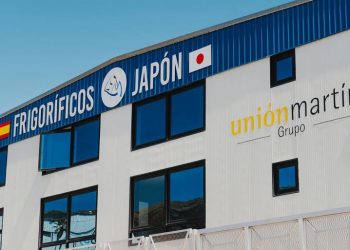
The Canary company originating from Lanzarote, the Noda family, is moving to another level. The investment bank Alantra, which was supposed to always leave the spotlight to Canary fishing talent, has sold one of the most important companies in the Port of Las Palmas, Unión Martín, with a turnover around 100 million euros as a result of its network of contacts and the influence of Canary capital in markets such as Mauritania and Morocco.
When Alantra bought it, according to sources from the sector consulted by Canarymaritime, the decision-making body was supposed to be in Las Palmas with Canary managerial staff. But that changed in 2025, and in less than a year, the fund is looking to divest the company. ‘At least they have sought a company from the sector,’ said a logistics operator from the Port of Las Palmas to this newspaper.
The company had operations in Valencia, and among its strongest clients besides the Japanese fleet were Hipercor, Mercadona, or Lidl. If Unión Martín’s management leaves the Canary Islands, the only fishing company based in Las Palmas with a tax headquarters is Russian: Norebo, prudently renamed as ‘Casa del Jurel.’
This ‘forced goodbye’ by Alantra is a symptom of the fragility of the local business fabric. The Godo venture capital is completing its cycle, reaping profits and handing over the keys to the fishing grounds to Vigo, leaving the 135 direct employees of the Canary workforce under the uncertainty of an integration plan that usually prioritizes efficiency in the Galician headquarters.
That is enough
The Mid-Atlantic board is witnessing a new maneuver of capital concentration that threatens to erase one of the last emblems of processed fishing in the Archipelago. Alantra Private Equity, the financial arm currently controlling Unión Martín, has begun shaping the exit of the Canary company towards the hands of the Galician giant Profand. What is read in Madrid offices as a ‘strategic divestment’ with capital gains is interpreted at the Port of La Luz as the last nail in the coffin of the industrial sovereignty of the Islands: another operator succumbing to the appetite of the continent.
The operation, confirmed this Monday following the start of a due diligence commissioned by the firm led by Enrique García Chillón, puts 600 families who depend on Unión Martín’s structure at risk, spread across the Canary Islands, Valencia, Mauritania, and Morocco. This move is an exact replica of an old score: companies that are born and grow under the advantages of the REF fiscal regime and the Canary-Saharan fishing grounds, only to end up inflating the balance sheets of multinationals from the Peninsula.
The end of uniqueness
Unión Martín is not a minor player. With a turnover of about 100 million euros and a volume approaching 20,000 tons annually, the firm has been for three decades the golden bridge between the Canary-Saharan bank and the shelves of Mercadona. The Canary group not only provides catches; last year, it inaugurated in Las Palmas the first freezer in the Islands capable of freezing at -60°C, a piece of cutting-edge technology intended for the sashimi market that will now be managed from Vigo.
The absorption by Profand—already part of the select club of billion-dollar companies with 1.009 billion in turnover in 2024—consolidates a Galician monopoly over the shopping basket of the archipelago. Profand, which devoured the Aragonese Caladero in 2019, uses the financial muscle generated in its plants in Vilagarcía de Arousa and Cambre to annex peripheral territories, eliminating the competition that Unión Martín represented in the FAO 34 area.
A port as a branch
The concern within the Port Authority of Las Palmas is tangible even if not openly expressed. The loss of Unión Martín’s decision-making center shifts the gravitational axis of the extractive business. While Profand announces investments of 43 million euros to triple its production in Galicia, the fear in the Canary Islands is that the Las Palmas plant will become a mere logistics terminal, a collecting branch with no financial autonomy or local reinvestment capacity.