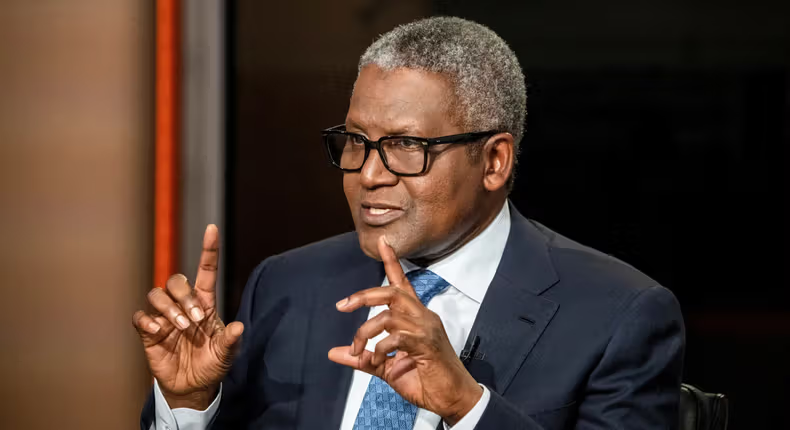
This may be operational by 2030. The industrial empire of Aliko Dangote, the richest man in Africa and leader in fuel supply to the Canary Islands, has begun preliminary movements for the construction of a deep-water port infrastructure on the Atlantic coast of Nigeria. The project, which is expected to cover an area of more than 10,000 hectares in the Olokola Free Zone, is strategically distributed between the coastal territories of Ogun and Ondo states. This move by Dangote Industries Limited into large-scale maritime logistics represents the conglomerate’s latest effort to transcend pure manufacturing and consolidate an integrated vertical export ecosystem designed to break the historical operational stranglehold that the Nigerian economy suffers.
Fertilizers
The technical design of the new infrastructure is configured to serve as the main gateway for the group’s industrial assets, unlocking the potential of its $20 billion petrochemical and refining megacomplex located in Lagos. The port facilities in Olokola will manage the bulk shipments of fertilizers, petrochemical products, and refined fuels that are already transforming the energy supply dynamics in West Africa while preparing the operational foundations for future liquefied natural gas (LNG) exports. Additionally, the port is projected to absorb the import of capital goods and heavy industrial infrastructure linked to the manufacturing and energy sectors across the region.
The conglomerate’s strategic decision responds to the urgent need to bypass the severe bottlenecks and exorbitant logistics costs that plague the congested ports of Lagos, particularly Apapa and Tin Can Island. These traditional terminals, which handle the majority of the country’s foreign trade, remain mired in chronic congestion that penalizes the competitiveness of the Nigerian export sector. The new deep-water hub aims to position the corporation within the framework of the African Continental Free Trade Area (AfCFTA), a treaty that demands a massive deployment of private capital in physical distribution networks to realize the potential of intra-African trade.
Trade
Preliminary technical missions for the project’s execution have already been activated on the ground under the leadership of Captain Jamil Abubakar, General Director of Infrastructure and Logistics of Dangote Industries. A delegation comprising environmental consultants and surveying teams has initiated institutional consultations in host communities, including formal visits to the towns of Ode-Omi in Ogun state, and to the coastal kingdoms of Araromi and Igbokoda in Ondo state. The traditional leaders of the affected districts, including monarch Oba Folailu Adekunle Hassan and Oba Adeoloye Olawole, have ratified their support for the project, authorizing the commencement of environmental impact studies, population censuses, and technical assessments for the corresponding financial compensations.
The project also has the approval of the military establishment, having received explicit backing from the commanders of the Nigerian Navy’s forward operations base in Igbokoda, a critical factor in ensuring the protection of future shipping routes against security risks in the Gulf of Guinea. With this push towards transport infrastructure, framed in its corporate strategy Vision 2030, Dangote aims to drastically reduce the export costs of the continent’s leading economy. By providing the country with a new Atlantic exit, the group accelerates Nigeria’s transition towards a diversified economic model, less dependent on crude oil sales and firmly anchored in heavy manufacturing and regional distribution.