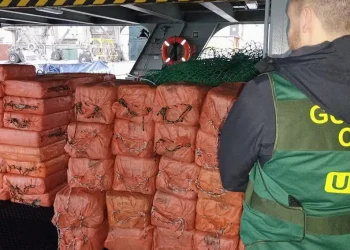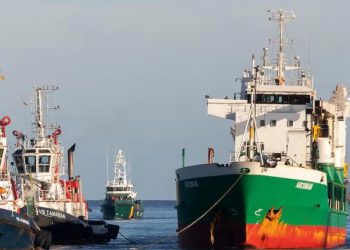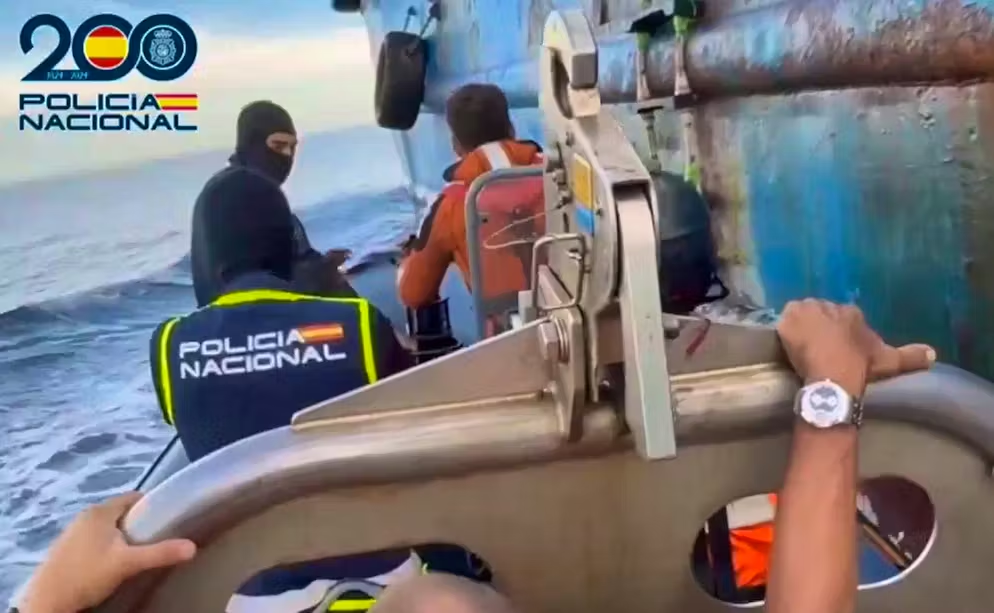
A highly complex operation led by the GEO of the National Police, with the support of the Spanish Navy and Maritime Rescue, has resulted in the seizure of a merchant vessel 290 miles west of the Canary Islands, in what is already considered the largest cocaine haul intercepted at sea. The cargo, according to specialized sources cited by narcodiario.com and Puente de Mando, is estimated to be around seven tons of cocaine. The merchant vessel, flagged in Cameroon, remains under custody with no details released about its name or the identity of the crew at this time. The operation once again confirms the strategic role of the Canary Atlantic as a corridor for international drug trafficking between Latin America and Europe.
Heading to Tenerife under military custody
Following the intervention, the vessel was integrated into a convoy escorted by the BAM Relámpago (P-43) of the Navy and the salvage vessel Heroínas de Sálvora, destined for Santa Cruz de Tenerife. However, it is not ruled out that the judicial and logistical disembarkation may eventually take place at the industrial port of Granadilla, located in the southern part of the island. Arrival is expected early on the morning of Monday, January 12, as part of an operation that includes exceptional security measures. The magnitude of the haul necessitates the activation of reinforced protocols both on land and at sea, given the complexity of unloading, custody, and subsequent destruction of the seized drugs.
The international context: 27 tons in two days
The operation off the Canary Islands coincides with an unprecedented international offensive against drug trafficking. Colombian President Gustavo Petro reported at the end of December that the Colombian National Navy managed to seize 27 tons of cocaine in just two days. Petro stated, “18 tons were seized in an operation near the Canary Islands, with the collaboration of European police. “
Petro described these actions as “one of the largest seizures in history over such a short period of time, with not a single death,” emphasizing that around 20 people were captured. The message also included a direct criticism of the United States for recent military attacks on alleged drug trafficking vessels in the Caribbean and the Pacific, which, according to the Colombian president, have resulted in more than a hundred civilian casualties in recent weeks.
Record production and pressure on Europe
The backdrop of these operations is a historic surge in cocaine production in Colombia. According to the latest data from the UN through its Office on Drugs and Crime, production skyrocketed by 53% in 2023, reaching 2,644 tons. The cultivation of coca leaves also increased by 10%, exceeding 252,928 hectares between 2022 and 2023.
The majority of this drug continues to be destined for the United States and Europe, despite the reinforcement of interdiction policies. Colombia’s Defense Minister, Pedro Sánchez, recently reported that between January 1 and early September 2025 cocaine seizures increased by 8% compared to the same period last year, while the destruction of clandestine laboratories grew by 21%. In that same time frame, 3,200 members of criminal groups were captured or killed, a 17% increase.
Canary Islands, at the center of the board
The interception of the merchant vessel 290 miles from the islands underscores a concern for European security services: the Canary Islands have become one of the critical points in the Atlantic in the fight against drug trafficking. The combination of transoceanic routes, large merchant vessels, and proximity to West Africa makes the area a key space for both criminal organizations and international interdiction operations. The intercepted haul not only sets a record for its volume but also highlights the global dimension of the problem and the need to maintain — and intensify — cooperation between police and naval forces on both sides of the Atlantic.