




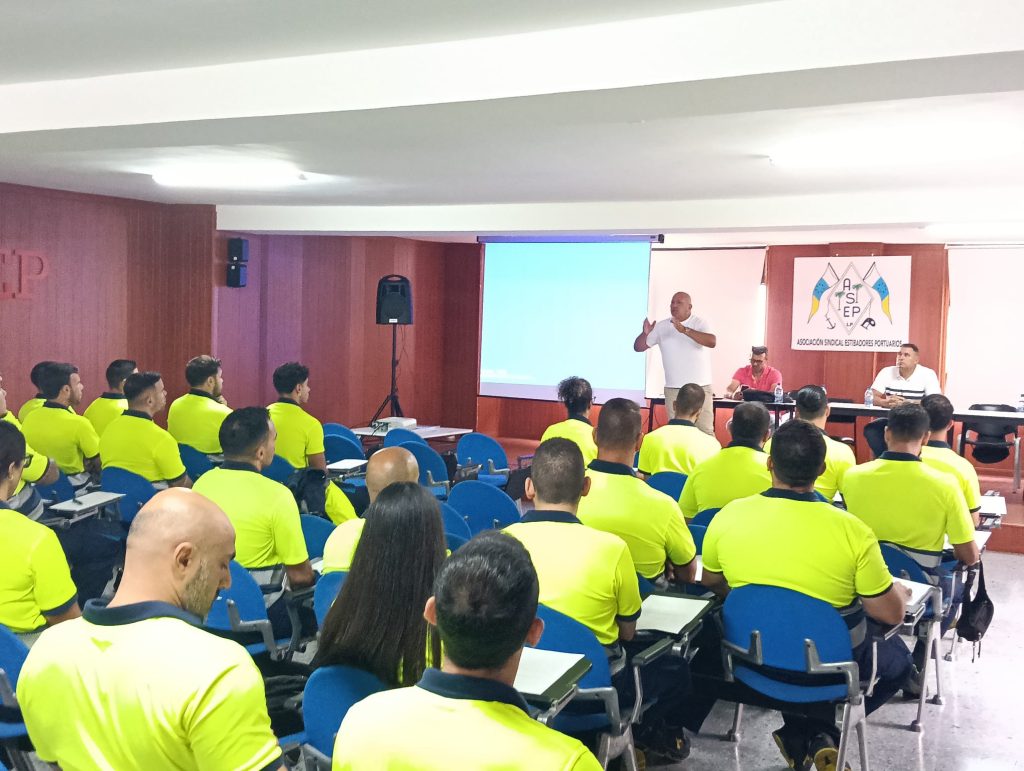
The record of 1.1 million TEUs with which OPCSA closed 2025 is not only a figure of commercial success; it is the fuel that the right-wing stevedoring in Las Palmas has needed to rearm itself. In a global scenario where the trend is towards liberalization and automation, the Port of La Luz is on track to exceed 600 stevedores in just two years, consolidating a model that seems frozen in time.
Lineages and “Movement Housing”: The Origin of the Bunker
To understand the power of the stevedores in 2026 in Las Palmas, it is necessary to look back. The current system is a direct heir to the purge of the dictatorship, when leftist stevedores were eliminated and replaced by falangist cadres and workers brought in from Andalusia and other islands. Those families, settled in La Isleta with housing granted by the Movement, created a closed ecosystem where access to work is governed by blood ties. While the Suez and Gulf corridors are reopening, the Port of Las Palmas is preparing to expand a workforce that maintains privileges and lineages inherited from the Movement. The right-wing union is pushing to secure 600 stevedores at a terminal, OPCSA, marked by low productivity and family control of employment.
Today, although a state-owned company formally manages the selection, the “right of birth” remains the invisible filter for this byproduct that Podemos and Sumar refer to as the Regime of ’78. The leader of this group, Maximiliano Díaz, has brought to the table the incorporation of a hundred new professionals this year, following the 90 already integrated in 2025. The declared goal is “stable employment for the youth,” a youth that predominantly shares surnames with the current workforce.
The Dilemma of MSC and BlackRock: Social Peace at a High Price
The ownership of OPCSA, shared by shipping company MSC (Aponte) and investment fund BlackRock, is at a crossroads. On one hand, the company has injected 90 million euros into new infrastructures to maintain its competitiveness. On the other, it faces a workforce that demands an unbreakable adherence document to its<strong union principles before accepting increases in workload.
The technical reality, however, questions the demands of the right-wing union. The productivity levels of stevedoring in Las Palmas are significantly below the standards of direct competitors such as Sines (Portugal), Lomé (Togo), or Santos (Brazil). Furthermore, the Port of La Luz largely operates as a ‘holding pen’ for MSC: a container storage terminal for empty containers whose logistical profitability is lower than that of major real cargo hubs.
Geopolitics of Containment: Stopping Maersk
If productivity is low and union pressure is high, why do MSC and BlackRock continue to bet on Las Palmas? The answer is not efficiency, but space occupation. The La Luz base is a strategic containment piece to prevent its major rival, Maersk, from gaining ground in the Central Atlantic. In this chess game, the stevedores play with the advantage of knowing they are indispensable for social peace at the port. While the world moves towards market openings, in La Isleta, the closed port scheme is still defended, using the shipping company’s million-euro investment as a hostage to ensure that the privilege system inherited from the last century suffers not a scratch.
News written by Gara Vega H. Edited and verified by José L. Jiménez. Cross-checked information without institutional filters. This analysis has not been funded by official advertising nor conditioned by lobbying interests.







