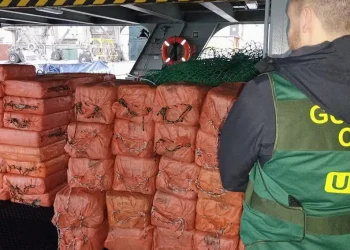
The maritime corridor linking West Africa, the Canary Islands and the Mediterranean is consolidating its status as a critical artery for the transatlantic trafficking of narcotics. Following the seizure of a massive cocaine shipment aboard the merchant vessel Arconian, intelligence analysis by Windward Maritime shows that criminal organizations operate according to a strategy of rapid asset replacement. A second general cargo vessel, with an operational profile and registration history identical to those of the Arconian, is currently sailing toward Ghana within the same logistical model.
The operational architecture identified follows a systematic pattern of maritime concealment. The newly investigated vessel shares the same risk factors that preceded the interception of the Arconian: advanced age, registration under the Comoros flag of convenience, ownership through a single-vessel company, and recent changes to its name and registration carried out over the past five months. These are compounded by deliberate shutdowns of the Automatic Identification System (AIS) lasting more than 48 hours and unexplained navigation patterns in Morocco’s Exclusive Economic Zone (EEZ).
The logistics axis exploits the Canary Islands’ geographic position as a transit platform toward the Iberian Peninsula and the major ports of northern Europe. Shipments originating in South America are introduced into West Africa—with recurring nodes in Guinea-Bissau, Sierra Leone and Senegal—for subsequent consolidation aboard coastal or general cargo vessels. In this dynamic, Mediterranean hubs such as Benghazi, Libya, have emerged as stopover and repositioning points on the southern Mediterranean flank, creating a closed-loop route that combines illicit trafficking with ostensibly commercial transit.
The continuity of this operation highlights the limitations of conventional port and maritime controls. Standard inspections based on registration checklists or basic AIS monitoring are insufficient to detect vessels that have legally changed their identities after periods of operating dark. For law enforcement authorities and maritime administrations in the Canary Islands area, dismantling these networks requires a shift from static vessel tracking to predictive behavioral intelligence capable of alerting authorities to operational deviations before the cargo reaches European territorial waters.
The article Drug-trafficking networks replicate the ‘Arconian’ near the Canary Islands: cocaine route to Europe was first published on canarymaritime.com.