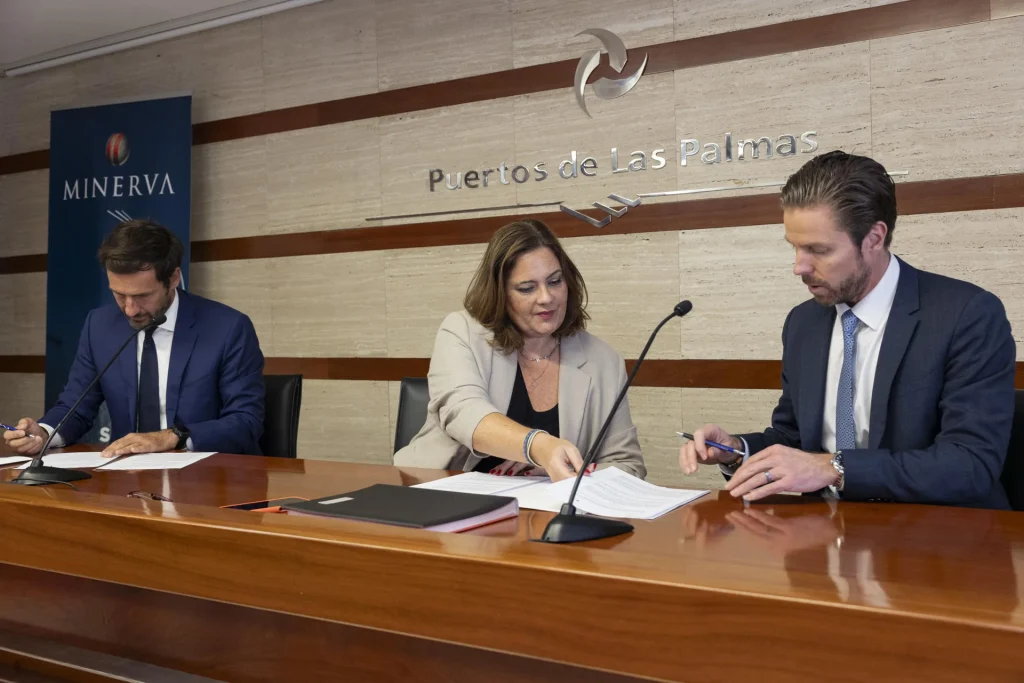
Minerva Bunkering, the marine fuel division of the Swiss giant Mercuria Energy Group, has formalized its entry into the West African market. After receiving authorization from the National Hydrocarbons Commission (CNHY) of Mauritania, the company has begun physical supply operations in a territory that has established itself as the new logistical friction point of the Central Atlantic. This move not only expands Minerva’s geographical footprint but also directly links the ports of Nouadhibou and Nouakchott with its distribution hub in Las Palmas in Gran Canaria.
The deployment of Minerva in Mauritania responds to a precise strategic calculation: to capture the value of a massive fishing fleet and, above all, to support the growing offshore oil and gas activity. With the launch of gas megaprojects at the maritime border between Mauritania and Senegal, the demand for high-quality fuels for support vessels and drilling platforms has escalated to levels that local infrastructure could hardly meet with guaranteed transparency. Tyler Baron, CEO of Minerva, emphasized in a statement to Canarymaritime that the goal is to reduce the total fuel cost by optimizing a supply chain that now enjoys unprecedented operational density in the region.
Logistics of Bunkering: The Las Palmas-Nouakchott Bridge
The Mauritanian operation relies entirely on the storage and refining capacity that Minerva controls in the Canary Islands. The company transports various grades of viscosity and fuel specifications from its hub in Las Palmas to the Mauritanian waters, using its own fleet of state-of-the-art tanker vessels. The supply tankers MT Symi, MT Tethys, and MT Karpathos have been designated as the permanent service units for this new area, ensuring that the quality and quantity (Q&Q) standards remain identical to those offered in the 150 global ports where the firm operates.
This business model allows Minerva to leverage the economies of scale of Mercuria, one of the largest private energy companies in the world, to acquire bulk products and distribute them atomized to a base of over 750 clients. In a market like bunkering, often punished by opacity in measurements, the entry of a player with the financial muscle of Minerva introduces competitive pressure that forces local and regional suppliers to professionalize their services to avoid losing market share in the bulk carrier and container ship sector.
Market Outlook in West Africa
The expansion into Mauritania places Minerva in an advantageous position against competitors that traditionally operated from offshore supply centers in West Africa. With physical bases in key ports, the company can offer shorter response times and greater reliability in the supply chain, critical factors for commercial shipping lines operating under strict arrival schedules. The dynamism of the region, driven by iron ore exports and emerging hydrocarbon wealth, guarantees a steady flow of large-tonnage tankers and bulk carriers.
For the Spanish port system, Minerva’s growth in the southern axis reinforces the role of the Canary Islands as the gas station of the Atlantic. The dependency of Mauritanian ports on the Las Palmas infrastructure confirms that regional logistics is now structured radially, with Canary ports acting as the supplying lung of an industrially developing African coast. With this license, Minerva not only sells fuel; it sells the security of supply necessary for the new energy sector of Mauritania to keep its gears moving.