




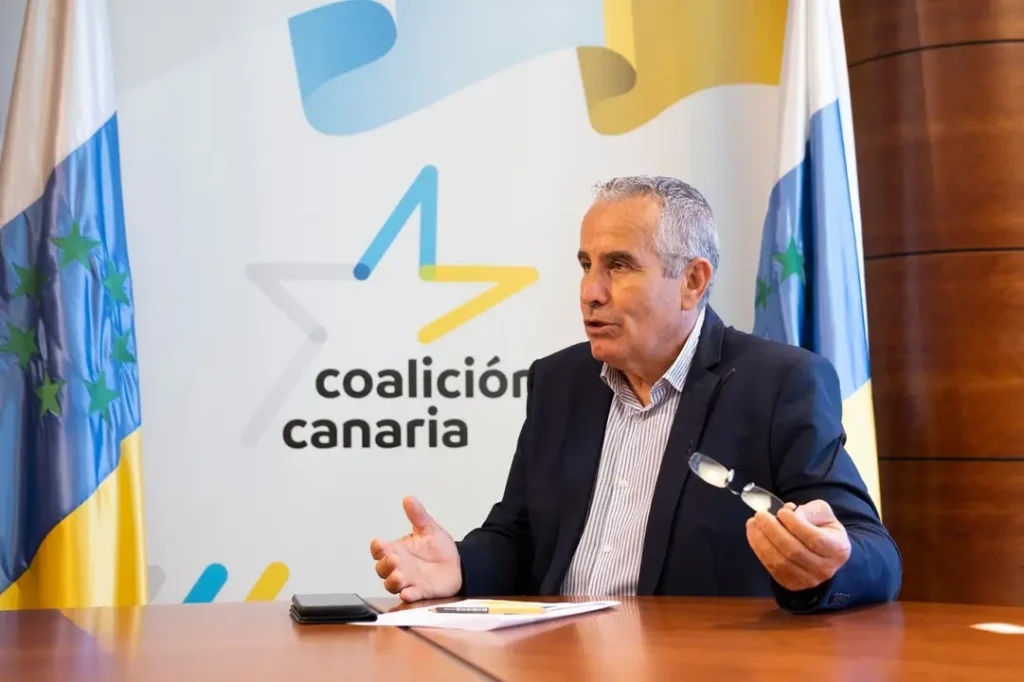
In the archipelago, politics is not a struggle of ideologies, but a choreography of geographic grievances. Mario Cabrera has chosen to break the decorum of the internal pact to highlight an obvious truth that all accept with resignation: the Port Authority of Las Palmas is an organism of geological structure, immovable, where the business community of Gran Canaria exerts a gravity that suffocates the smaller islands. ‘The board of directors of the Port of Las Palmas is archaic, we have directors borrowed from the Government of the Canary Islands,’ said Cabrera. ‘We think of the whole of the Canary Islands when decisions need to be made, we have excellent profiles in Fuerteventura or Lanzarote,’ he stated.
By asking for a majorero or a lanzaroteño to preside over the entity, Cabrera is not suggesting an administrative reform; he is denouncing the exhaustion of a model that confuses Canary unity with the hegemony of the capital’s dock. It is the last gasp of a periphery that, tired of being considered ‘second-class’, claims its right to manage the horizon, while Clavijo’s Government watches the spectacle of being questioned by its own people in a mix of dirty realism and electoral survival.
The power structure supporting the Port Authority of Las Palmas faces a frontal challenge from the eastern islands. Mario Cabrera, General Secretary of AM-CC in Fuerteventura and regional deputy, has put forth a proposal that fractures the administrative tradition of the entity: the presidency of the Port of Las Palmas (CC) must fall, for the first time, to a representative from Fuerteventura or Lanzarote. This claim is not only a gesture of territorial balance but a comprehensive amendment against what Cabrera describes as an ‘archaic’ system conditioned by the centralism of Gran Canaria. ‘They make us go on a war footing,’ said Cabrera.
Cabrera’s argument is simple: the presidency of the Port of Las Palmas manages resources from three islands, but its benefits and strategic visions seem to flow in one direction. By proposing profiles from Lanzarote or Fuerteventura to lead the entity, the majorero nationalism seeks not only representativity but a change of model that allows the ports of Arrecife and Puerto del Rosario to compete on equal terms in the complex map of maritime transport in the Central Atlantic.
For Cabrera, the board of directors of the Port Authority of Las Palmas operates under a ‘crushing majority’ of Gran Canarian interests, both institutional and business, relegating the peripheral islands to a secondary role. This asymmetry in decision-making, according to the deputy, is the direct cause of the ‘double cost’ logistics that Lanzarote and Fuerteventura endure and the stagnation of critical infrastructure that could diversify the province’s economy.
The Tarfaya factor: the trigger of the conflict
At the heart of this demand is the systematic blockade of the maritime line between Tarfaya (Morocco) and Puerto del Rosario. Cabrera links the lack of progress on this trade route to a strategy of concentration of benefits in Gran Canaria. ‘In Fuerteventura and Lanzarote, we have another concept of understanding the Canary Islands,’ said the nationalist leader, suggesting that the opening of the line with Africa is seen by certain Gran Canarian sectors as a threat to their own logistical interests.
Even within the majorero island itself, Cabrera detects resistance: ‘There are intermediaries who see that their business could collapse if this line opens.’ However, business pressure does not cease. The Chamber of Commerce of Fuerteventura has joined the criticism, denouncing a port hierarchy where there are ‘first and second-class islands’. In this scenario, the Government of the Canary Islands has been requested, through Proexca, to arrange a business expedition to reaffirm the viability of the route with Morocco.
A pulse for regional governance
The proposal for an alternating presidency of the Port Authority of Las Palmas represents a significant movement in regional politics. While the appointment is a State-delegated responsibility proposed by the autonomous Government, Cabrera’s approach seeks to force a negotiation where the balance of power is no longer strictly demographic but functional.







