The energy landscape of West Africa is about to gain a key player in its production board. Akrake Petroleum, a subsidiary of Lime Petroleum (under the umbrella of Singapore’s Rex International Holding), has confirmed that the historic Sèmè field, off the coast of Benin, is in the final stages for its definitive startup. After a halt lasting more than a quarter of a century, oil will flow again in the first week of February 2026.
The Sèmè field is a well-known entity in the sector. Discovered by Union Oil in 1969 and originally operated by Norway’s Saga Petroleum, the field was a cornerstone for the local economy between 1982 and 1998, a period during which it produced approximately 22 million barrels of oil. However, the collapse of oil prices in the late 1990s dictated its premature closure.
Now that the new year has arrived, with renewed infrastructure and a barrel price that justifies investment in secondary recovery, Lime Petroleum is not only looking to extract the remaining resources but also to reposition Benin on the regional exploration map. If deadlines are met without further setbacks, February 2026 will mark the beginning of a new energy era for the African country.
The reactivation of Block 1, an area of 551 square kilometers in waters of just 20 to 30 meters deep, has not been without obstacles. Although drilling operations with the jack-up rig Gerd from Borr Drilling successfully commenced in August 2025, a series of technical setbacks forced a postponement of the production start initially scheduled for the end of last year.
The focus of the operation is now on the production well AK-2H, specifically designed to drain the western section of the H6 field. In these critical days, the technical crews are finalizing the installation of screens in the well —essential for filtering the sandstone formation— and the placement of an electric submersible pump (ESP) at the bottom of the well, the mechanical ‘heart’ that will push the oil to the surface.
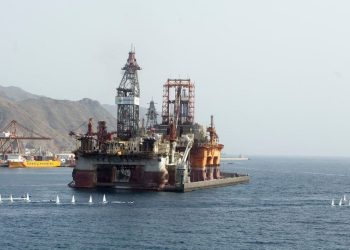
To ensure the project’s viability, Akrake Petroleum has deployed cutting-edge logistics adapted to the shallow waters of Benin. The mobile offshore production unit (MOPU) Stella Energy 1 and the floating storage and offloading unit (FSO) Kristina are already in the final installation stages. This integrated system will enable autonomous processing and storage of the extracted oil, facilitating its subsequent export to international markets.