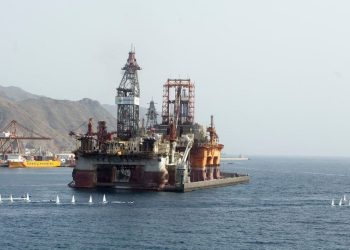
The dizzying race by intermediaries and investment funds to deploy offshore wind megaprojects along the Canary Islands’ coast has encountered a direct obstacle at the European Parliament. The European Parliament’s Committee on Petitions (PETI) has decided to keep open the case concerning Petition 0620/2026, submitted by the Miracanarias Shipowners and Fishermen’s Association, which questions the feasibility, scientific rigor and environmental sustainability of developing offshore renewable energy in the archipelago. Vox has immediately asked Brussels for data following the presentation by Canary Islands fishermen.
Airam Mederos, president of Miracanarias and the National Association of Small-Scale Fisheries (ANARME), appeared in Brussels alongside Domingo Martín Afonso, the group’s secretary for institutional relations. In a presentation backed by the Pescatobal and Pescarestinga cooperatives and the Platform for the Canary Sea, representatives of the primary sector warned of the latent threat of losing traditional fishing grounds and the lack of established scientific guarantees regarding the actual impact of these infrastructures on benthic ecosystems and marine biodiversity.
Scientific uncertainties and risks to the benthic environment
Mederos’s intervention was based on technical documentation concerning the interaction between energy emissions from offshore wind facilities and seabed communities. The sector argues that the scientific information available to public authorities contains critical gaps in key areas: the projection of electromagnetic fields generated by submarine cables, continuous vibrations, sediment disruption, irregular biocolonization processes and changes to food webs.
In opposition to the official discourse promoting the accelerated occupation of maritime space, the fishing group called for comprehensive studies to measure the long-term cumulative and synergistic effects of these turbines. The shipowners’ position is that existing doubts cannot be resolved at the expense of the marine environment or by shifting operational risks onto the small-scale fishing fleet, based on the false premise that a lack of data is equivalent to an absence of environmental harm.
Demand for transparency in the state’s planning
The debate in Brussels highlighted doubts over the authorization process and maritime spatial planning applied by the Spanish government. Although representatives of the European Commission recalled the EU regulatory framework requiring environmental impact assessments and compliance with the Habitats and Birds Directives, they left the specific responsibility for processing the applications to the national authorities.
Miracanarias bases its complaint on the need to determine what scientific documentation was available when regulatory decisions were made in Spain, how it was used and to what extent meaningful participation by the fishing sector was ensured. The group rejects the idea that decisions capable of shaping food sovereignty and economic activity on the islands for decades can be adopted without fully verifiable technical traceability.
European Parliament support and the international dimension of the dispute
The case received support from a range of political groups during the committee session. Jorge Buxadé, a member of the European Parliament from the Patriots for Europe group, demanded that the Ministry for Ecological Transition immediately provide all administrative reports processed as part of the Spanish case. For her part, MEP Ana Miranda (BNG/Greens/EFA), a member of the Committee on Fisheries, called for maximum transparency and stressed the need to protect small-scale fishing from the unchecked expansion of industrial projects at sea.
The impact of the complaint launched from the islands extends beyond Spain’s borders. Documentation from the Dutch government sent to its Parliament on September 24 — linked to case 21501-32-1841 — confirms that the Dutch authorities are monitoring the progress of Petition 0620/2026. The country’s administration has confirmed that it will assess whether decisions taken by the European Commission on the Canary Islands case require a review of its own offshore wind farm planning in the North Sea. The European Parliament will now await a formal written response from the EU executive before deciding on the next steps.
The article The Canary Islands’ offshore wind bubble runs into Vox and small-scale fisheries in Brussels was first published on canarymaritime.com.