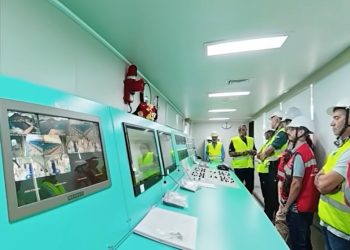
The operational restart of the Sèmè offshore field in Benin has reignited debate over the commercial viability of abandoned oil reserves on the African continent. Nearly three decades after operations were halted in 1998—when oil was trading at $14 a barrel and 22 million barrels had been extracted—Canada’s Akrake Petroleum Benin has resumed commercial production at a rate of 3,000 barrels per day, with the first international cargo of 250,000 barrels scheduled for October 2026.
The operation is based on a strategy to minimize fixed costs in shallow waters by leasing floating units in depths of just 20 to 30 metres. The model makes it possible to develop approximately 5.7 million barrels of proven and probable reserves, providing an operational benchmark for a range of African assets that remain stuck in the technical or economic evaluation phase.
Mauritania’s case illustrates the gap between the size of a discovery and its actual development along the Atlantic margin. Following the closure and dismantling of the Chinguetti field in 2017, Mauritania’s Energy Ministry continues to evaluate the Walata and Tevet fields, with estimated reserves of 280 million and 40 million barrels of crude, respectively. Despite the resource’s scale, financial viability requires development models capable of ensuring profitability in the face of the high capital costs of offshore infrastructure.
Geological and logistical factors similarly constrain other key projects on the continent. In Namibia’s PEL39 licence, meanwhile, Shell recorded a $400 million impairment in 2025, while light crude discoveries at the Merlin-1X well in June 2026 have prompted renewed commercial viability studies.
The revival of these assets coincides with an uncertain outlook for long-term energy consumption. The International Energy Agency projects global demand at 113 million barrels per day by 2050 under current policies, while OPEC’s analyses put the figure above 124 million barrels per day. Against this backdrop of diverging forecasts, private capital allocation will favor short-cycle projects with low extraction costs, with viability depending on operators’ technical flexibility to compete on costs during the energy transition.
Offshore: West Africa’s Dormant Oil Fields Confront Global Demand Uncertainty was first published on canarymaritime.com.