The financial restructuring of offshore energy infrastructure operators is usually completed away from the water, but its impact is measured directly on the docks. The Norwegian driller Dolphin Drilling, listed on the Euronext market, has consolidated a radical turnaround in its balance sheet during the first half of the year, backed by a comprehensive renewal of its executive team, its shareholder board, and the refinancing of its structural debt. In the latest earnings teleconference, the newly appointed CEO of the firm, Jon Oliver Bryce, certified the company’s return to operational profitability by recording an EBITDA of 10.4 million dollars in the first half of 2025, a figure that contrasts with the negative EBITDA of 23.2 million dollars noted in the same period of the previous year.
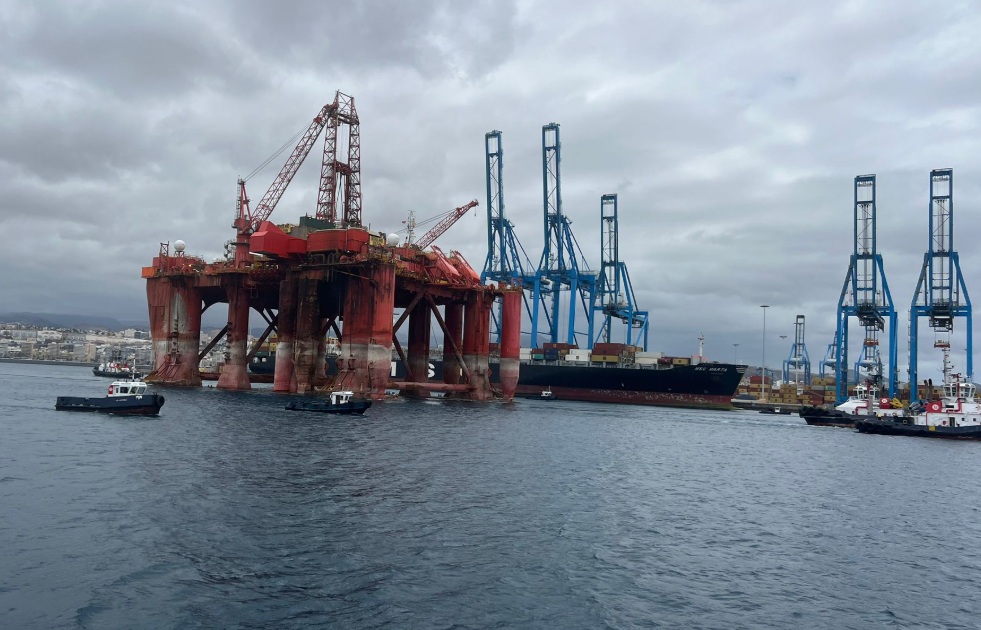
The presence of this drilling giant in Las Palmas reaffirms the archipelago’s status as the most competitive contingency space in the euro-African corridor. Dolphin Drilling’s management argues that the global supply of anchored semi-submersible rigs is notably limited, coinciding with a sustained uptick in global demand for this equipment. CEO Jon Oliver Bryce identifies a business reactivation divided into two differentiated market niches: conventional hydrocarbon drilling and an increase in well plugging, permanent abandonment, and decommissioning contracts for obsolete wells. By retaining the Borgland Dolphin in the Las Palmas port facility, ready to be reactivated for any emergency bidding in the North Sea or along the western coast of Africa, the Norwegian firm positions itself advantageously to capture projects in a highly competitive energy market.
The improvement in the corporation’s total revenue, which soared to 93 million dollars compared to the scant 30 million dollars billed in the first half of 2024, reflects the reactivation of the anchored semi-submersible platform market. However, the accounting cleanup still coexists with inherited fiscal distortions. The company’s CFO, Ingolf Gillesdal, detailed that Dolphin Drilling is carrying a net loss of 26.2 million dollars (0.09 dollars per share) due to an adverse tax impact of 19.2 million dollars. Despite this burden on net income, the entry of Svelland Capital as a long-term strategic investor with a 49% stake provides the company with the necessary solvency to contend for the collection of the arbitration award against General Hydrocarbons Ltd. in Nigeria.
The commercial viability of the company rests on the performance of its floating assets, where the Canary Islands play a fundamental role as a maintenance base and strategic positioning. While units with firm contracts record high levels of activity —with the Paul B Loyd Junior platform achieving a utilization rate of 98% in the British North Sea for Harbour Energy until 2028 and the Blackford Dolphin operating at 86% capacity for Oil India until 2026—, the crown jewel for its future bids is managed from the Mid-Atlantic. The semi-submersible platform Borgland Dolphin remains moored in a state of technical inactivity at the port of Las Palmas, a location deliberately chosen to minimize fixed maintenance costs while being actively marketed in international markets.