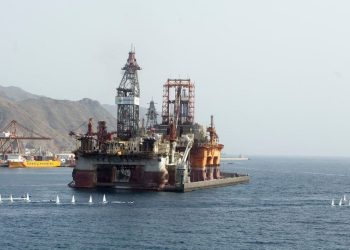
The consolidation of Santa Cruz de Tenerife as an operational base for offshore giants will transform the port into the logistical hub of a West Africa that accelerates its drilling until 2040. The plans of the president of the Port Authority of Las Palmas, Pedro Suárez, envision growth knowing that it will be a platform that not only provides services but will also reduce the carbon footprint of specialized vessels’ stays.
The horizon of the port of Santa Cruz will not only be measured in cranes and cruise ships, but in the imposing steel of drilling vessels that will connect the capital of Tenerife with the depths of the Gulf of Guinea. The strategic alliance between the American giant Noble Corporation, the British Tullow Oil, and the Italian ENI has placed Granadilla at the nerve center of a renewed oil rush in West Africa, making the island an indispensable component of the energy machinery of the South Atlantic.
Suárez has been able to read the map: while West Africa provides the resource, Santa Cruz de Tenerife supplies the technical intelligence and stability. In this new oil rush, the island is not merely an observer from afar; it has become the silent yet indispensable partner that enables the machinery of the Gulf of Guinea to continue drilling successfully.
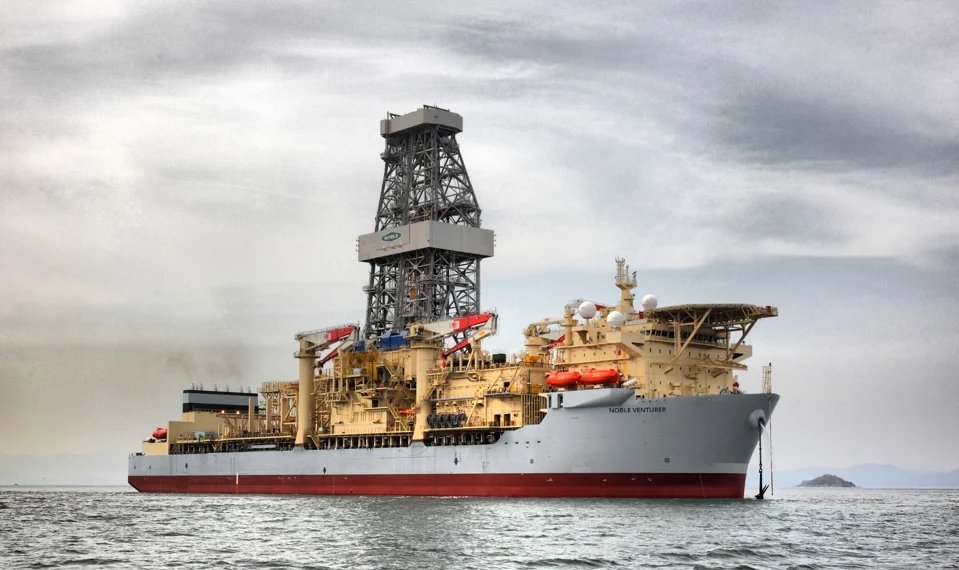
The news that well J-74 in the Jubilee field, off the coast of Ghana, will soon begin production has heightened expectations at the Tenerife docks. This is no small matter: the drilling vessel Noble Venturer, a regular in the islands, has certified the discovery of a net 50-meter layer of crude oil that will raise production to 70,000 barrels per day. For Santa Cruz de Tenerife, every barrel extracted in Jubilee is a confirmation of its status as the high-tech workshop and the preferred ‘gas station’ for multinational companies fleeing the logistical instability of the neighboring continent.
The roadmap: 20 wells and a horizon until 2040
What captured the attention of port operators in 2026 was not only the success of J-74 but also the long-term ambition. The Ghanaian government has secured Tullow’s licenses and its partners until 2040 allowing for the planning of up to 20 additional wells. This ‘logistical bridge’ ensures that the flow of rigs and support vessels between Tenerife and Africa will not be a fleeting phenomenon, but an industrial constant for the next two decades.
The entry of ENI is also noteworthy, as they, alongside Noble and Tullow, seek to optimize extraction and storage operations. The planned acquisition of the floating unit FPSO TEN by 2027 marks another milestone on the calendar: these gigantic storage ships require technical maintenance of an extreme specialization that only ports with the legal security and technical capacity of Tenerife can offer in this part of the world.
The pull effect is evident. The reactivation of drilling by Noble Corporation acts as a magnet for underwater engineering companies, suppliers of critical spare parts, and last-mile logistics services. Each time Tullow Oil announces a new well, like the four producers already approved for this cycle, it is like a blessing for the islands.
The situation with ENI
The Italian energy giant Eni has sealed an agreement to sell a partial stake in a gas and oil development project off the coast of Côte d’Ivoire to the State Oil Company of the Republic of Azerbaijan (SOCAR). Thanks to a binding agreement with Eni, SOCAR will acquire a 10% interest in the Baleine project, considered the main offshore development in Côte d’Ivoire, operated by the Italian giant (operator, 47.25%) in partnership with Vitol (30%) and Petroci (22.75%). The closing of this transaction is subject to the necessary regulatory approvals and other usual terms and conditions.
The Baleine field was discovered in 2021, two decades after the last commercial discovery in the country, and reached production in 2023. This sale aligns with the operator’s strategy to optimize its upstream portfolio by accelerating the monetization of exploration discoveries through capital divestment, a model known as the dual exploration model. The agreement is also consistent with the broader collaboration between the two companies, which signed three memoranda of understanding (MoU) in 2024, focusing on energy security to enhance cooperation in hydrocarbon exploration and production, as well as reducing greenhouse gas (GHG) emissions and the biobased fuel production chain.
News written by Pedro Marrero. Edited and verified by Gara Vega. Cross-checked information without institutional filters. This analysis has not been funded by official advertising nor conditioned by lobbying interests.