




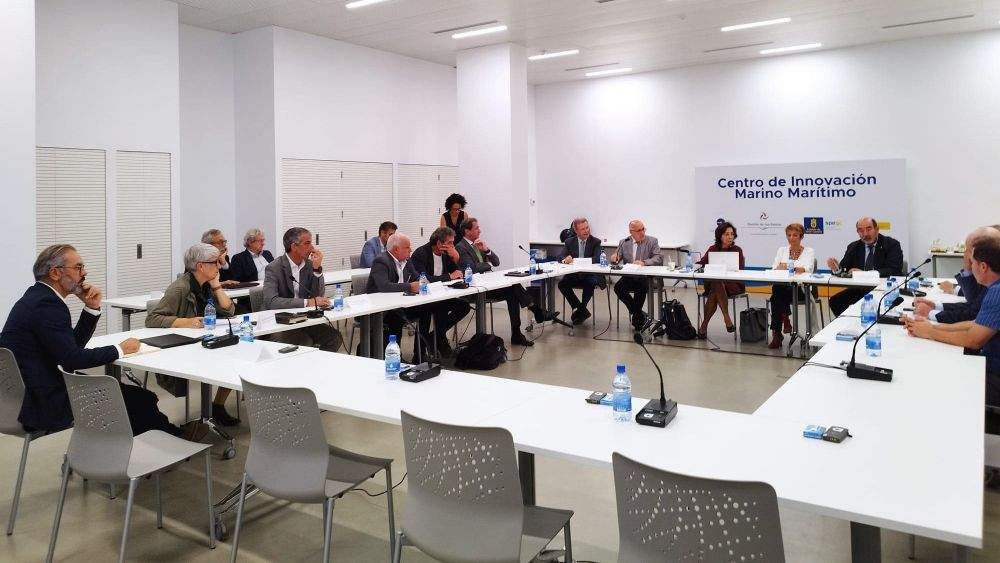
It is not a lobby, it is something else. There are silences that thunder or bubble more than any speech, and the one surrounding Antonio Morales in his defense of the Oceanic Platform of the Canary Islands (Plocan) in 2026 is deafening. The president of the Gran Canaria Cabildo appeared at the end of January to denounce a ‘sustained neglect strategy’ and a ‘slow death of the crown jewel of marine research in the islands’. But all those who benefit from the blue economy through SPEGC maintain a sepulchral silence. The supposed business fabric that, in theory, should be the biggest beneficiary of this infrastructure is silent.
Despite this, they even brought to Las Palmas during Vicente Marrero’s time the EU Commissioner for Fisheries María Damanaki, now an advisor to the hotel chain managed by Suzanna Laskaridis. One thing is to assemble wind turbines and another is the civil base of Plocan unless the idea is to create a self-contained Plocan at the port of Las Palmas.
For entrepreneurs, Plocan is a vital tool, but not a hill worth dying on politically. The private sector has opted for a discreet negotiation path with Madrid and Santa Cruz de Tenerife, prioritizing investment stability over the claim of institutional sovereignty championed by the Gran Canaria Cabildo. Morales has made it clear that he will not be ‘an accomplice’ to the degradation of Plocan. However, in this journey, the Cabildo president finds himself sailing alone. The blue economy lobby, which he himself helps to feed, seems to have decided that its future lies in the offices of the ministries, not on the barricades of the island corporation.
In Canary Islands politics, the business of the blue economy has learned to move with the caution of a submarine. While Morales harshly criticized the Spanish Government and the Canary Islands Government for the ‘deliberate underfunding’ of the center, the major players in the sector preferred to stay out of the picture. For the industrial lobby, fighting with Madrid or the regional government over an issue of island governance is a luxury they cannot afford on the eve of the first offshore wind auctions.
The ‘sin’ of institutional exclusion
Morales, accompanied by his advisor Raúl García Brink, without representation from the Gran Canaria Chamber of Commerce, presented technical arguments that verge on the scandalous: a salary mass frozen since 2014, deteriorated facilities, and an absolute dependence on European funds amidst state and regional abandonment. ‘Europe is sustaining its activity while the State and the Canary Islands Government have kept its basic structure frozen,’ he concluded.
However, the point of real friction is control. Morales denounced the ‘systematic veto’ that prevents the Gran Canaria Cabildo from entering the Plocan Board of Directors, an exclusion he labeled as ‘difficultly justifiable’ comparing it to the Astrophysics Institute of the Canary Islands (IAC), where the Cabildos of Tenerife and La Palma do have a voice and vote. The island president suspects that they do not want ‘institutional witnesses’ to the degradation of the center, but his complaint has not found resonance with employers or maritime clusters.
Plocan has attracted more than 100 million euros in investment and leads international floating wind trials, but its internal structure is bleeding talent towards the private sector or foreign centers where salaries are not ‘hibernated.’ The ‘neglect strategy’ that Morales denounces could actually be a symptom of a paradigm shift in the management of R&D&i in the Canary Islands: one where the Cabildo has shifted from being the driving force to being an uncomfortable actor at a table where Madrid and the regional government prefer to manage without local interference.
News written by Gara Vega. Edited and verified by Pedro Marrero. Cross-referenced information without institutional filters. This analysis has not been funded by official advertising nor conditioned by lobbying interests.







