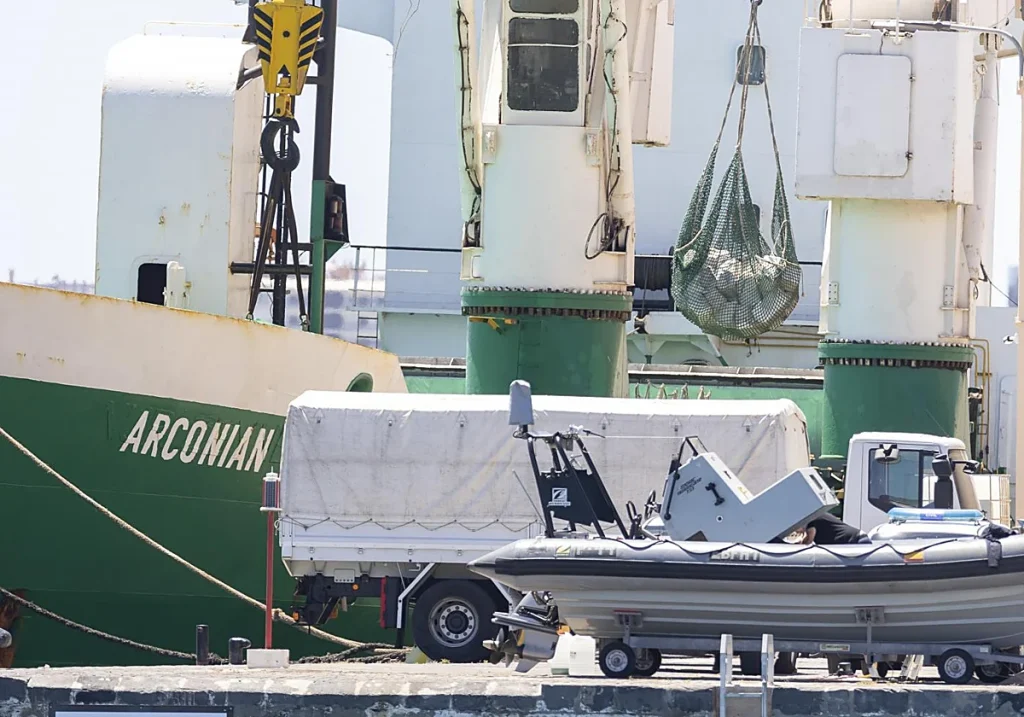
The business of large-scale international drug trafficking in the Mid-Atlantic has encountered a severe judicial setback that consolidates the prerogatives of Spanish criminal prosecution in complex interventions at sea. The Fourth Chamber of the Criminal Division of the National Court has issued several rulings this May, which Canarymaritime has accessed, rejecting appeals filed by the defense of Filipino crew members, fully confirming their provisional imprisonment without bail following the boarding of the cargo ship Arconian.
The Court justifies the need to maintain the precautionary measure based on the gravity of the criminal offenses charged, which include drug trafficking with the aggravating factors of a significant amount and extreme severity due to the use of commercial vessels, membership in an organized crime group, possession of flammable substances, and possession of war weapons.
The tribunal dismisses the defense’s arguments regarding the lack of individualized indications and emphasizes that the defendant completely lacks labor, family, or economic ties in Spain. The judges conclude that the high penalties associated with these charges and the economic capacity of the transnational network to facilitate an escape justify maintaining the penitentiary regime to ensure the defendant’s availability before Spanish justice.
The ruling by judges Teresa Palacios Criado, María de los Ángeles Montalvá Sempere, and rapporteur Francisca María Ramis Rosselló validates the use of provisional detention in an strictly instrumental manner. This legal figure, provided for in Article 505.5 of the Criminal Procedure Act, empowers the judicial authority to decree deprivation of liberty due to the material impossibility of bringing the arrested individuals to judicial facilities or ensuring a telematic appearance with guarantees within the constitutional timeframe of 72 hours, due to the geographical contingencies of an interception in international waters.
A militarized infrastructure at sea
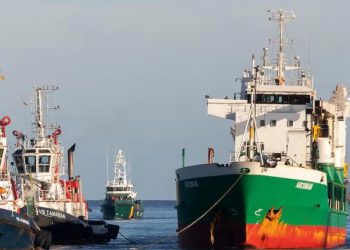
The resolution details an extraordinary transcontinental maritime transport operation. On May 1, 2026, at 18:25, the Civil Guard ship Duque de Ahumada located the cargo ship Arconian, a vessel flying the flag of the Comoros and owned by the company Serenity Shipping SL LNT, whose headquarters is located in Freetown (Sierra Leone). The ship, which had loaded the illegal merchandise near the African coasts, was sailing 250 nautical miles southeast of the Canary Islands with the aim of transferring the cargo to fast boats for introduction into the mainland market.
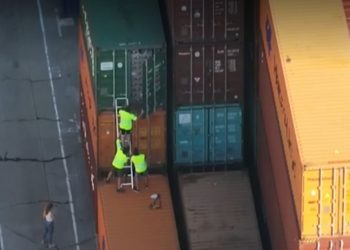
The raid, carried out at 20:30 by the Special Intervention Unit (UEI) of the Armed Institute, culminated in the arrest of its 23 crew members and the discovery of an arsenal that reflects the professionalization and militarization of the criminal organization. After the ship’s arrival at port, the subsequent judicial inspection on May 6 uncovered a record cargo of 1,279 bales of cocaine with a total gross weight of 30,215.84 kilograms, with an estimated value in the illicit market of 812,201,779 euros.
The risk of flight before severe penalties
Along with the narcotic, agents seized three assault rifles, one pistol, five magazines, ten intact boxes of ammunition, and a logistical deposit consisting of 2,108 gasoline jugs of 20 liters each, intended to ensure the autonomy of the liaison boats. The technological inventory seized, key for intelligence analysis, includes three laptop computers, 28 mobile phones, four nano SIM cards, and external storage devices.