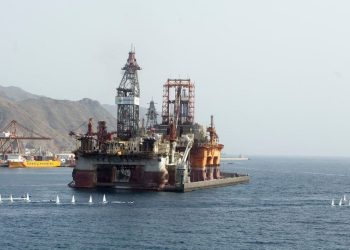
The news has hit the offices of the consignees in Las Palmas and Tenerife like a ton of bricks:Transocean swallows Valaris in a $5.8 billion operation. This is not just an accounting move in Houston; it is the birth of a colossus with 73 platforms that, from now on, will look at the Canary shipyards with one sole objective: to impose its cost law. ‘It is agreat news, we are very prepared, they will apply greater controls on foreign labor,’ said an executive of an ETT familiar with the industry in the Canary Islands on Monday.
The financial analyst Gustavo Martínez, a professor in the Canary Islands from Universidad Hespérides and UFM, stated on Monday that Transocean’s acquisition of Valaris ‘represents another relevant chapter in an environment marked by high levels of volatility and adjustments in strategic markets’ and that ‘this trend has already been evidenced in recent episodes, such as the historic record in the silver differential between China and the West. Such dynamics underline the importance of carefully analyzing the impact of these operations for investors and the sector as a whole.’
Until the beginning of this month, Valaris and Transocean were competing for space and services, allowing local suppliers to play with margins. With a unified fleet and $200 million in ‘synergies’ promised to shareholders, the new direction of Transocean will centralize purchases. The order will come chewed from Texas: either the Canarian suppliers lower prices by volume, or the immense scale of this new fleet will take repairs to other competing nodes.
A seasoned financial veteran in the sector in Las Palmas is clear: ‘Transocean is going to impose an iron capital discipline. We will see fewer units idle and much more aggressive and faster maintenance processes‘. It is the end of an era and the beginning of high-intensity logistics.
The paradox is that, despite the pressure on prices, the workload could skyrocket. With a $10 billion order book and the drilling boom off the coasts of Namibia and Guyana, the Canary Islands are once again the inevitable workshop in the middle of the Atlantic. ‘We have 33 deepwater drilling vessels that now belong to a single owner; if the Canarian ports wake up with digitalization and the supply of new fuels, they secure the business of the decade,’ said a specialized source in the sector in the Canary Islands.
The challenge now is technical because the new giant operates the most advanced fleet in the world and will not settle for quick fixes. They will demand high-end services, total traceability of the carbon footprint, personnel, and an administrative agility that, to this day, remains the great Achilles’ heel of the port bureaucracy in the islands.
News written by Raquel Molina. Edited and verified by Pedro Marrero. Information cross-checked without institutional filters. This analysis has not been funded by official advertising nor conditioned by lobby interests.