




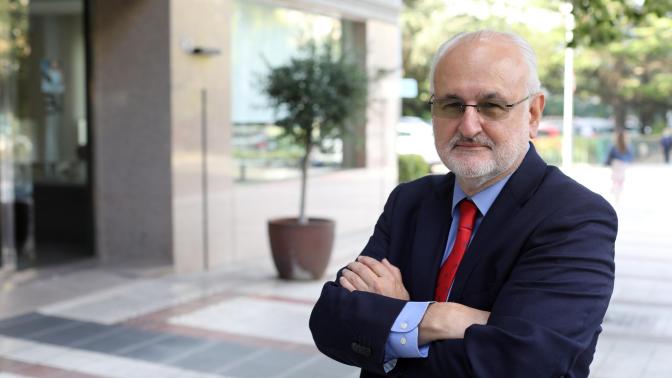
The professor at UNED and international relations analyst, Florentino Portero, stated this Monday during a conference on the Sahara titled ‘The New Scenario and Its Impact on Spain’ at the Real Sociedad Económica del País de Gran Canaria, that the Exclusive Economic Zone (EEZ) has become the Gordian knot of Spain’s foreign policy in the Canary Islands. Morocco, with a roadmap that could be described as aggressive pragmatism, has not hidden its intention to expand its maritime competencies, overlapping with Spain’s commitments to the United Nations.
In his view, logistics is not just a matter of containers and drafts; it is a chess game where borders are liquid and resources, invisible. While the Port of Las Palmas is physically expanding with multimillion-dollar investments, a shadow of political uncertainty looms over the surrounding waters. The relationship with Rabat, marked by a historic diplomatic asymmetry, has shifted from a complex neighborhood to a direct challenge over the sovereignty of resources.
The Subsoil
Control of the waters implies dominion over the resources of the seabed, a treasure of critical minerals whose exploitation is now the epicenter of national security. Morocco has always been clear about its objectives; Spain, on the other hand, seems to be navigating without a compass, he said, pointing to Madrid’s tendency to concede positions in favor of a diplomatic peace that could mortgage the islands’ energy future.
In his opinion, the Canary Islands find themselves at the vertex of this pincers movement. The loss of influence of France in the Sahel is not only a diplomatic defeat for the Élysée; it is a strategic vulnerability for Brussels and a reminder that Las Palmas is the last frontier of Europe facing a continent in redefinition. For the Canary Islands, this means that the value of its critical infrastructure—its ports and airspace—multiplies, but so does its exposure to the tensions of a global supply chain that increasingly depends on who controls the subsoil and African land routes.
News written by Raquel Molina. Edited and verified by Pedro Marrero. Information cross-referenced without institutional filters. This analysis has not been funded by official advertising or conditioned by lobby interests.







