




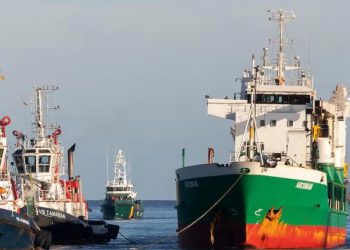
The port of Las Palmas has become the stage for one of the major milestones in the fight against global drug trafficking. On May 3, the Civil Guard escorted the Arconian, a 37-year-old cargo ship, following a boarding operation in Moroccan waters off Dakhla. Hidden in its hold was a shipment of industrial dimensions: between 30 and 45 tons of cocaine destined for the European market. However, beneath the official triumphalism, maritime intelligence data reveals a disturbing reality: the operational success has not deterred the method of evasion. The Arconian represents the archetype of a low-value general cargo ship, ideal for high-risk operations where the vessel is expendable. Under the Comoros flag and owned by an opaque company based in Sierra Leone (Serenity Shipping SL Ltd), the ship operated under a structure designed for legal irresponsibility. Its history prior to interception is a manual of concealment tactics: the cargo ship disappeared from AIS systems for over a month at the beginning of the year, long enough to undergo a radical identity change. The structured evasion methodology employed by the Arconian is cyclical and reproducible. On March 15, after its period of darkness, the vessel reappeared in Senegal’s waters with a new name, a new MMSI number, and a different flag. By breaking the continuity of its digital trail, the cargo ship presented itself to automated control systems as a new entity, unlinked from its risky past. This technique, already documented in previous cases such as the MV Raider, demonstrates that criminal networks possess administrative logistics capable of manipulating international records as swiftly as they move the goods. The chosen route was not coincidental. The Arconian was transiting the West Africa-Canaries corridor, a logistical axis where South American cocaine is stored in ports such as Freetown or Guinea-Bissau before making the final leap to Europe. The declared destination of the vessel was Benghazi (Libya), a node that has gained strategic relevance in recent months as a logistical stop in the southern Mediterranean for networks operating in the Atlantic. The volume of the seizure of the Arconian—historic due to its tonnage—suggests the existence of a coordinated fleet rather than an isolated shipment. The fall of the Arconian highlights the limitations of surveillance systems based solely on the declared identity of vessels. Maritime intelligence warns that port state control is insufficient when faced with convenience records that do not report their own anomalies. The risk does not lie in the name of the ship but in the behavioral pattern that precedes its arrival. The methodology of identity restoration remains operational, and other vessels are successfully executing it at this very moment. While the Arconian remains under custody in Gran Canaria, the Atlantic corridor remains open, with a fleet of obsolete cargo ships and untraceable owners betting on digital darkness to cross the European border. The record seizure is a tactical success, but the logistical war at sea is far from over.





© 2026 canarymaritime