




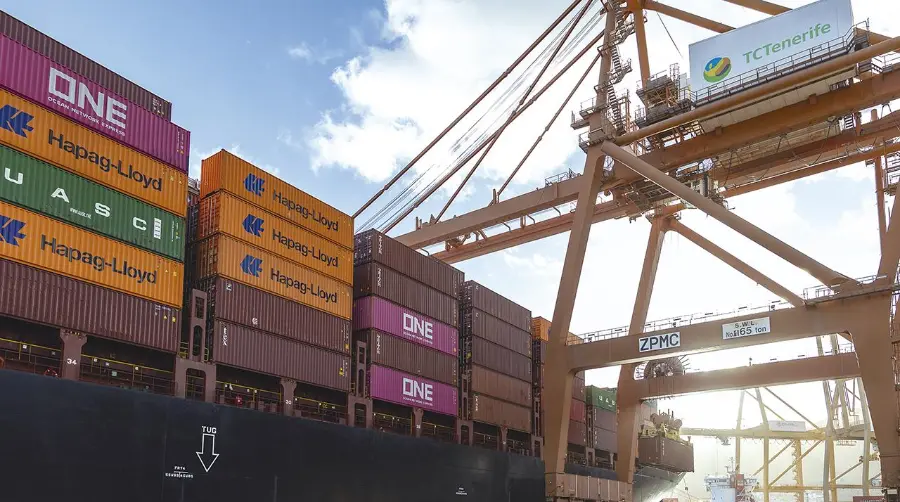
The West African commercial board is witnessing a new movement of pieces by one of the largest operators in the world. Hapag-Lloyd, the fifth-largest container shipping company globally, has announced the official opening of its new office in Cotonou, Benin. This decision, effective from May 20, marks the end of reliance on indirect regional networks in the country and grants the German company a dedicated physical presence in a market that has transformed from being a secondary destination to becoming a strategic node in the transatlantic supply chain. The company continues with its plan to strengthen services in Tenerife, as sources from the group confirmed on Tuesday.
The selection of Benin is not a coincidence. Under the umbrella of its ambitious Strategy 2030, Hapag-Lloyd seeks to capitalize alongside the Canaries on the sustained growth of an economy that has massively invested in modernizing its port infrastructure. The port of Cotonou is not only the economic lifeblood of the country; it serves as the main transit terminal for massive and geographically isolated inland markets such as Niger and Burkina Faso. By establishing a local base, the German shipping company ensures operational control over a land corridor that is vital for the flow of goods to the heart of the Sahel.
The transition to an owned office reflects a paradigm shift in Hapag-Lloyd’s client management in the subregion. Jesper Kanstrup, General Manager for Africa of the company, has been explicit in stating that this physical presence is ‘a fundamental step’ to gain agility and responsiveness. In a sector where the reliability of liner shipping is measured by problem-solving at the last mile, direct contact with local partners in Cotonou will allow the Hamburg firm to offer tailored solutions, distanced from the standardized protocols of external agencies.
Hapag-Lloyd brings formidable logistical firepower to this market. With a global fleet of 301 container ships and a capacity of 2.5 million TEU, the shipping company aims to more aggressively integrate Benin into its 133 line services. The opening in Cotonou facilitates local exporters’ access to a network that connects with more than 600 ports worldwide, reinforcing the position of the Beninese port against regional competitors like Lomé in Togo or Lagos in Nigeria.
The movement in Benin should also be viewed in terms of vertical integration. Hapag-Lloyd has diversified its business towards the Terminals and Infrastructure segment, with stakes in 21 terminals at strategic points in Europe, Latin America, and North Africa. By strengthening its commercial office network in West Africa, the company prepares the ground for future logistical synergies. The presence of 400 offices in 140 countries underscores the scale of an organization that employs 18,000 people and now sees the Gulf of Guinea as its next major growth vector.
For the local market, the official arrival of Hapag-Lloyd signifies a validation of Benin as a first-class logistics center. The long-term commitment of the German shipping company suggests that stability and facilitation of trade in the region have reached a maturity threshold sufficient to attract direct investments from industry titans. At a time of reconfiguring global routes, Cotonou ensures a seat at the table of major shipping companies, guaranteeing quick connections and, above all, direct communication with the decision-making center in Hamburg.







