




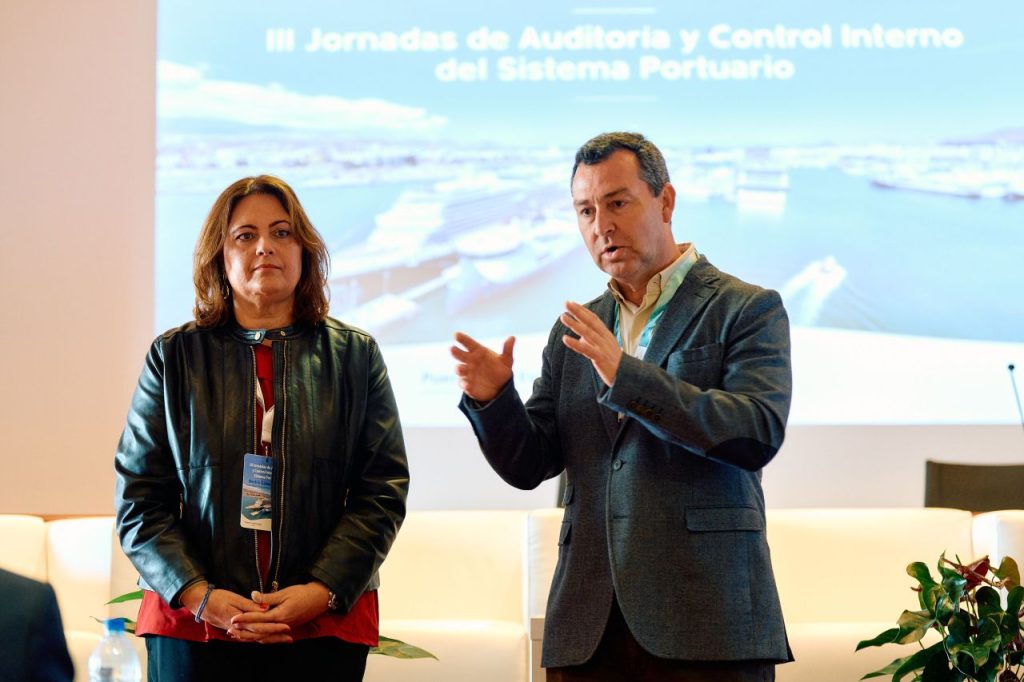
The state-owned port system has closed ranks around transparency and administrative rigor. During the III Days of Auditing and Internal Control, held from April 23 to 24 in the capital of Gran Canaria, the president of Ports of the State, Gustavo S., and his counterpart in Las Palmas, Beatriz Calzada, led a technical conclave aimed at safeguarding public management. With the participation of 25 Port Authorities, the meeting focused on the increasing complexity of the verification requirements imposed by the European Commission, at a time when the execution of FEDER and FEMPA funds sets the pace for investments in Spanish docks.
The appointment was not merely consultative. The presence of the General Intervention of the State Administration (IGAE) and the General Directorate of European Funds underscores the oversight pressure to which Port Authorities are subjected. The message from Ports of the State is clear: the internal control model must be homogeneous to avoid fissures that could jeopardize the arrival of European capital. In a decentralized system where each port manages its own budgets, the unification of criteria in audits and action plans has become the greatest guarantee of financial survival for infrastructure projects.
The operational framework governing these workshops is the Internal Control Plan approved in December 2025. This strategic document, already applied by Port Authorities, structures oversight into four critical blocks: ordinary control actions, specific audits of European funds, action plans to correct deviations, and special reports. This architecture aims to professionalize internal inspection, elevating it from a bureaucratic task to a strategic management tool that allows for the detection of inefficiencies before they are flagged by external control bodies.
For the port of Las Palmas, acting as host of this meeting reinforces its profile as a solvent administrative node within the national network. In an environment where the competition for European Union funds is fierce and the requirements for sustainability and digitization are increasingly strict, institutional coordination between the Ministry of Finance and the Ministry of Transport is crucial. The Spanish port system is thus preparing for a cycle of investments where success will be measured not only by the tonnage moved, but by the impeccability of the documentary trail left in Brussels.







