




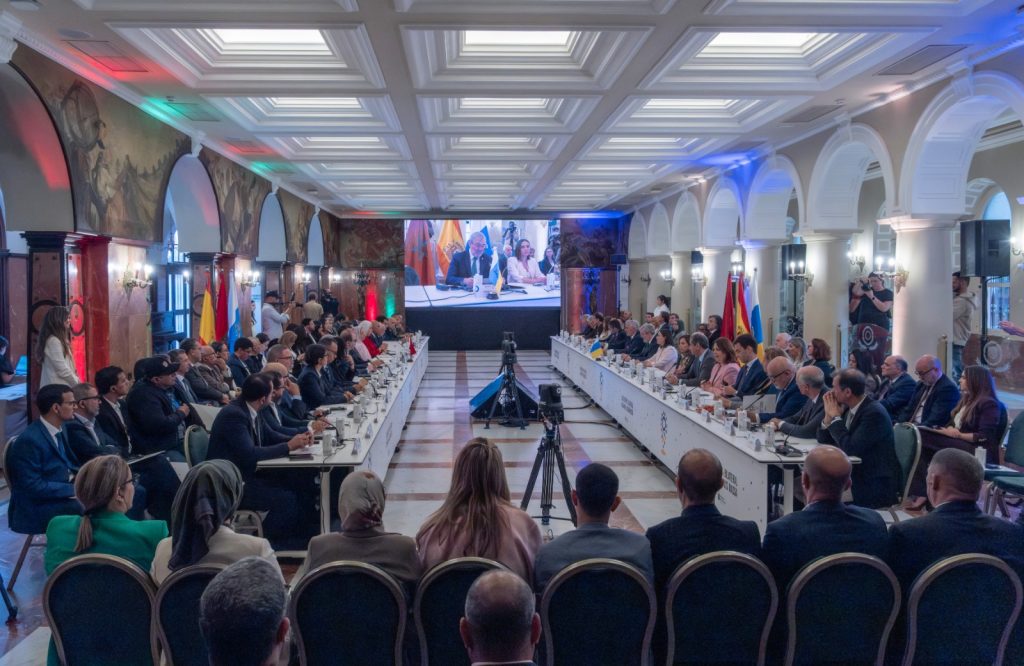
They are still waiting for Tarfaya. The liturgy of **’neighborhood cooperation’** has once again occupied the official agenda with the same script as always, but with a bulkier packaging. On this occasion, 80 representatives from the Souss-Massa region have disembarked in Gran Canaria to discuss the same issue that was on the table in the 90s: a regular maritime line between Agadir and Las Palmas. Fernando Clavijo insists that the commercial missions are already **’bearing fruit’**, although when asked about the numbers, the response returns to the realm of the abstract. The inability of officials to quantify in euros the benefits of these meetings confirms that, for now, the main export product of these summits is the **official paperwork** and the **protocol allowances**.
The Port Authority of Las Palmas, led by **Beatriz Calzada**, has limited itself to **’evaluating’** formulas to facilitate business, a comfortable administrative position that avoids real financial commitments. While Morocco promotes its Atlantic facade as an unstoppable hub, the Canary Islands seem content with playing the role of host to a **’blue economy’** that no one quite knows how translates into the profit margins of local SMEs. Skepticism is inevitable: if the line with Agadir were the deal of the century that institutional discourse suggests, shipping companies would already be fighting for the concession instead of waiting for a **’technical follow-up commission’** to explain how to make money.
Between Globalization and Empty Promises
The rejection of **’protectionism’** criticisms made by sectors such as the Cabildo of Gran Canaria has been the only moment of firmness in a press conference dominated by vagueness. Clavijo defends that **’introspection is a mistake’**, but does not clarify how he will prevent the Canary Islands from becoming the **useful fool** of a globalization that, in this case, seems to favor only the export of Moroccan products to Europe, using the Canarian docks as a **free platform**. The mention of **’university research exchanges’** sounds more like padding for the statement than an economic engine capable of sustaining a weekly rotation of a cargo ship.
The result of this high-level summit is the creation of two new commissions: one technical and another for follow-up. In the language of the **Canarian administration**, this is usually the euphemism used to archive projects that do not fit the reality of the market. Until a ship loaded with non-subsidized goods is seen, the Agadir-Las Palmas line will remain what it has been for the last thirty years: an excellent excuse for official trips and a logistical **chimera** that sinks every time it faces a **spreadsheet**.







