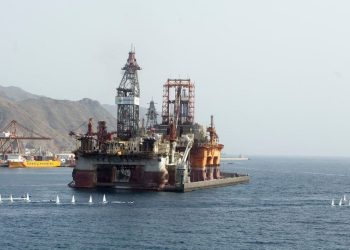
The United States Department of Defense has set its sights on Tenerife for the operational readiness of one of its most versatile logistics assets. The USAV Major General Charles P. Gross, a Frank S. Besson Jr. class vessel designed for heavy cargo transport, is completing its ninth day of stay on the island under the technical control of Tenerife Shipyards. This operation underscores the operational shift of the U.S. Navy and Army towards the Canary auxiliary industry, seeking to ensure the operational capability of their missions in the strategic Rota-Atlantic corridor.
Capable of transporting up to 15 battle tanks and hundreds of tons of material, the Charles P. Gross is a key piece in the logistical support framework of the Pentagon since its entry into service in 1991. Its current presence is not an isolated event: the vessel docked at the East dock in October 2024 for similar interventions. The recurrence of these technical stops within less than two years evidences that Washington not only values the geographical location but has validated the technical capacity and adherence to strict military standards of the Tenerife shipyards compared to competitors on the African coast or in Southern Europe.
Naval Efficiency Amid Political Debate
The vessel will undergo maintenance work until May 3. The operation has reignited the debate over the use of civil infrastructure for military purposes, with formations such as the pro-Russian Podemos expressing outright rejection and linking the ship’s stay to the military instability in the Middle East. For the industrial sector of Santa Cruz, the focus is strictly professional. Securing direct contracts with the United States Government represents a boost in high-value workload and positions the Canary capital among the elite of global naval repair.
The USAV Major General Charles P. Gross, with its 84 meters in length, acts as a barometer of external confidence in the Tenerife brand. The discretion and operational efficiency of Tenerife Shipyards in managing these assets—from the Rota naval base—reinforces the thesis that the Canary port has evolved from a simple bunkering station to a first-tier industrial partner. By betting on Tenerife’s technology and security, the Pentagon transforms the islands into an indispensable logistical link for its long-range operations on NATO’s southern flank.