




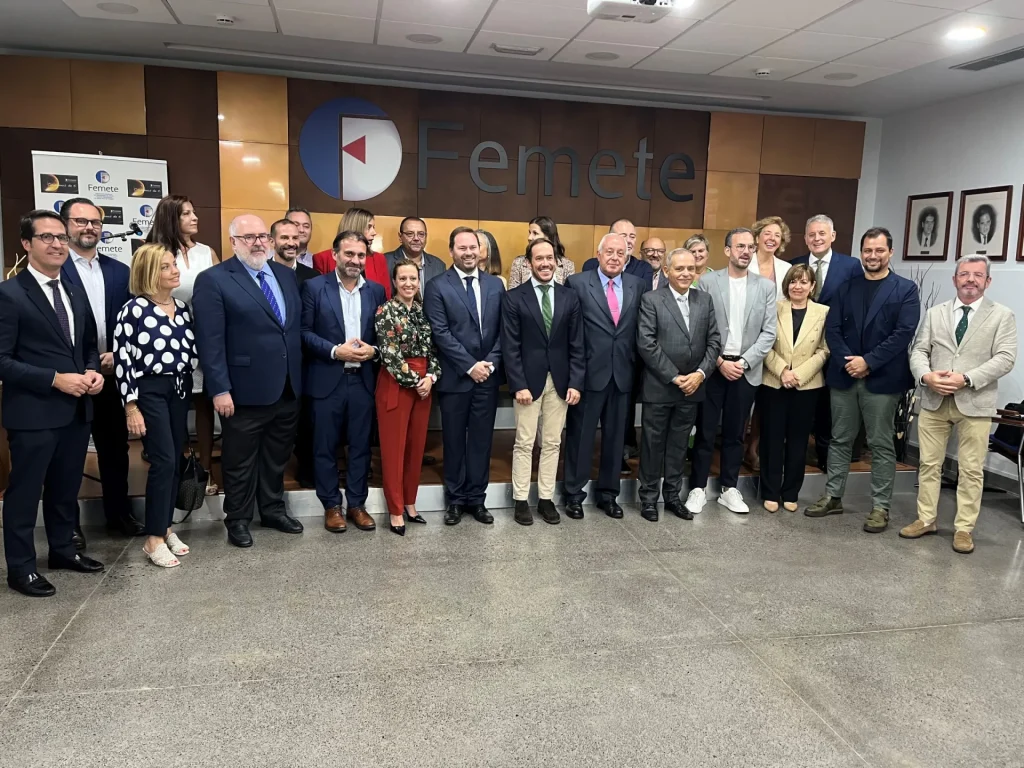
In the margins of the Canary Islands economy, there are organizations whose real importance does not appear in the headlines. One of them is the Provincial Federation of Metal Companies and New Technologies of Santa Cruz de Tenerife, 117 workers, known in the business ecosystem as Femete. Its 2024 accounting reveals an institution that has learned to navigate skillfully at the intersection of private enterprise, public administration, and employment policies.
The fiscal year closed with 5.11 million euros in revenue, compared to 4.32 million the previous year. However, this figure only gains significance when its composition is analyzed: 3.97 million comes from public subsidies, while business contributions provide 1.13 million. The rest corresponds to the provision of services and training activities.
Femete maintains a direct dependency on its own subsidiary, Tenerife Metal Training (FMT), to which it owes two loans totaling a principal of 475,000 euros, with interest rates ranging from 3% to 4.35%. This structure allows for the flow of capital to circulate between the parent company and its subsidiary, reinforcing the group’s autonomy in relation to traditional banking, which carries a debt of 1.85 million euros.
The total personnel cost amounted to 3.18 million euros. The balance sheet also reflects a financial structure characteristic of entities linked to public programs. The total assets reach 7.69 million euros, while the net worth stands at 536,969 euros. A significant portion of the assets corresponds to credits owed by public administrations, derived from granted subsidies that are pending collection or justification.
The real heavyweight on the balance sheet is its tangible fixed assets, dominated by an industrial building valued at 2.77 million euros, which, after renovations and the inclusion of land valued at 204,000 euros, serves as the anchor for the institution as it acts as collateral for its main mortgage loan. The auditor of the house, José Ramón Díaz Alonso, could not avoid including a paragraph of emphasis that resonates as a warning for navigators: unprescribed subsidies are subject to verification by the granting bodies. This is not an insignificant detail in an organization that closed 2024 with subsidy income of 3.97 million euros.
The vulnerability becomes more evident when observing that the tax agency owes the federation 4.98 million euros pending collection, while on the liabilities side, a ‘ghost’ of 4.46 million euros awaits in convertible debt subsidies. This is money already received but is technically still a debt until the inspector formalizes the justification of the projects.
Beyond the coldness of the large numbers, the 2024 report reveals details that provide almost a customary color to the management of the employers’ association. Noteworthy, due to its picturesque nature, is the case of the embargo by the Santa Cruz de Tenerife City Council: there is a balance of 10,454 euros that remains ‘trapped’ due to a dispute linked to a capital gains tax from 2015, a small bureaucratic speck in a million-dollar machinery that the Federation fights in the courts. In parallel, the fiscal chapter stands out: despite doubling its profits, the expense for corporate tax was 0.00 euros. This efficiency is due to its partially exempt entity regime and the skillful use of negative taxable bases from previous years, allowing every euro earned to stay in-house.







