




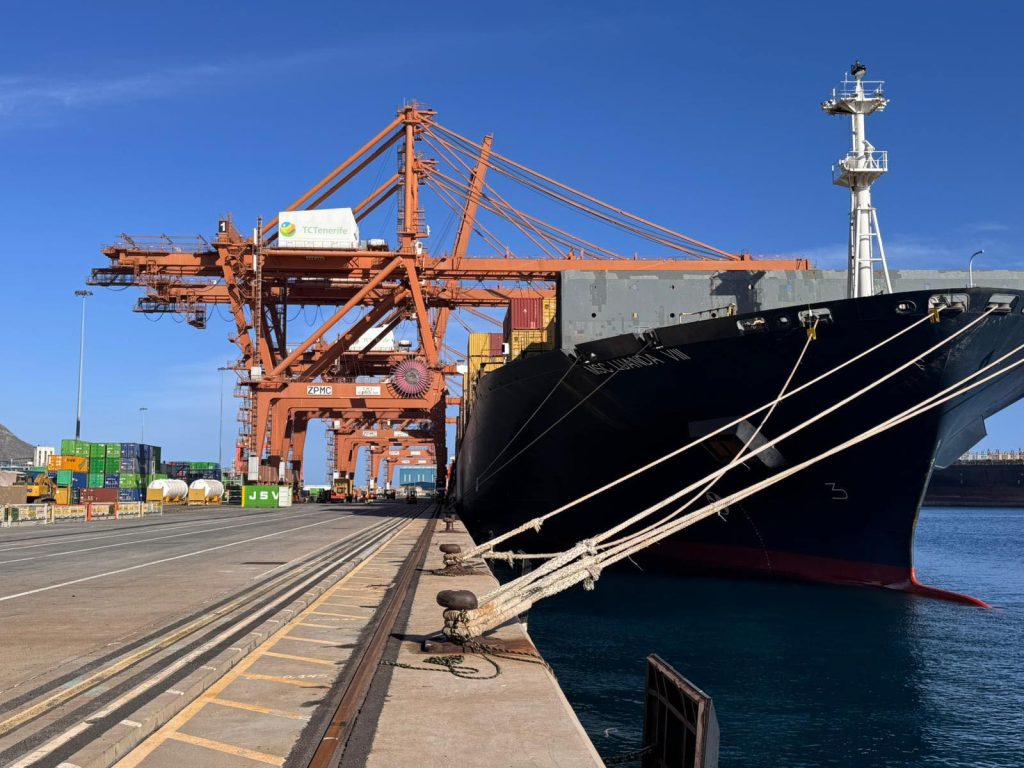
The battle for control and stability of the vulnerable Canary Islands electrical system has added a critical regulatory chapter in Madrid. The Regulatory Supervision Room of the National Commission on Markets and Competition (CNMC) has issued a strong ruling against Red Eléctrica de España (REE), upholding the access conflict raised by the firm Field Iberia Bess. The administrative resolution requires the system operator to process the application for a 32 MW battery energy storage plant at the high voltage junction Dique del Este, located in the Port of Santa Cruz de Tenerife, revealing a deep lack of transparency in the management of island networks.
The origin of the commercial dispute lies in the technical management of a critical infrastructure to mitigate the recurring energy zeros of the archipelago. REE had outright rejected the application from the private promoter, claiming that the only planned position at the said 66 kilovolt (kV) substation was exclusively reserved for emergency generation power. However, the market supervisor determines that the operator acted unlawfully by applying a non-existent inadmissibility cause under current regulations, requiring a complete reversal of administrative actions.
The Illusion of Available Megawatts
The CNMC’s ruling highlights a governance error by Red Eléctrica that has persisted for months in its official channels. According to the analyzed records, the web platform of the transmission system manager published an available access capacity of 32 MW at the mentioned Dique del Este junction in September 2025, a figure that the operator itself raised to 44 MW in November of the same year. At no time did the monthly capacity publications indicate technical restrictions or refer to the special exclusive regime for emergencies resulting from state planning.
The supervisor emphasizes that Royal Decree 1183/2020 establishes a closed list (numerus clausus) of legal reasons for inadmitting an application, based on the lack of financial guarantees, the formal declaration of a capacity contest, or the absolute absence of available megawatts. Since none of these circumstances were present at the time of submitting the project named ‘Dique 23’, the CNMC concludes that REE distorted procedures by declaring a summary inadmissibility, creating a false appearance of capacity that induced the promoter to make expenditures and engineering investments on a technically blocked junction.
Island Emergency versus Private Investment
The technical background of the conflict is directly connected to the extraordinary measures approved by the Council of Ministers in July 2025 to increase the resilience of networks in non-peninsular territories. That modification of the Transport Network Development Plan 2021-2026 incorporated 65 urgent actions aimed at controlling voltage and stability against fluctuations in the Canary Islands and the Balearic Islands. Subsequently, Order TED/909/2025 recognized the economic repercussions for installing 71.6 MW of rapid emergency generation in Tenerife, strategically distributed between the Granadilla Industrial Zone and the Port of the capital of Tenerife under the protection of Royal Decree 738/2015.
These emergency facilities have an exceptional legal regime: they are not registered in the production administrative record, do not count towards the ordinary coverage of demand, and are only dispatched by ministerial order in the face of an imminent risk of structural blackout. The CNMC clarifies that, while REE maintains the legal obligation to safeguard that position for the Government of the Canary Islands’ contingency groups, it should have accepted Field Iberia’s storage request to conduct an individualized feasibility study. It is in that subsequent technical analysis, and not in the registration phase, where the system operator must justify in a reasoned manner whether the entry of the batteries is compatible with emergency equipment.
An Archipelagic Scope Requirement
The CNMC’s ruling transcends the specific case of Tenerife and sends a structural warning to the system operator regarding the transparency of its digital platforms. The ruling requires Red Eléctrica to immediately modify, within a maximum of five days, its capacity publications for the Dique del Este 66 kV junction, clearly specifying the restrictions linked to supply security. Additionally, the regulator requires the company chaired by Beatriz Corredor to thoroughly review the rest of the substations and junctions of the electrical systems of the Canary Islands and the Balearic Islands to verify whether capacity reserved by law for contingency generation is being offered to the general market.
The resolution opens a path of uncertainty for the plans to deploy mass storage in the islands, a technology considered essential by the autonomous government to stabilize the grid and integrate wind and photovoltaic parks. By decreeing the reversal of the file, REE is now obliged to issue a detailed technical report justifying why a 66 kV position designed for emergencies cannot accommodate or be hybridized with commercial battery systems, a document that the promoter Field can audit in court if a new technical rejection is received during the connectivity phase.







