The dials of Maxorata have lost their fundamental frequency. It is said that death always arrives in silence, but in the case of Santiago Travieso, it must have faced the inconvenience of a voice that knew no silence, for there are men made of words just as others are made of bones, and Santiago was one of those, a weaver of waves who dedicated half a century to sending sounds into the wind of Fuerteventura to see if, by a twist of fate or tuning, people would start to understand each other, or at least listen to each other, which is already asking a lot in these times of deaf blindness.
He was born in a capital that looks out to the sea and went to a desert that gazes into the void, and from this movement between shores and dunes he drew the certainty that radio is nothing more than a form of company for those who are alone and a warning for those who believe they are accompanied by power, so that when he founded his own house of words, that Radio Sintonía, now left orphaned of a father and a criterion, was nothing but a wall of air against forgetfulness and silence, that silence which now, finally, has gotten its way by taking the man but leaving, as happens with echoes in caves, the trace of a voice that still seems to tell us, good morning everyone, except for one.
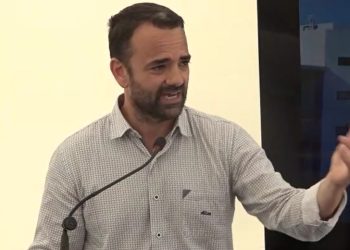
Santiago Travieso, the man who turned radio into a civil counter-power from the rigor of independence, passed away this May 6, leaving a void that journalism in the Canary Islands will take decades to fill. Born in Gran Canaria but shaped in the harshness of the Sahara and the complexity of a Fuerteventura in full development, Travieso was not only a broadcaster; he was the architect of a majorera public opinion that learned to doubt and debate thanks to his microphone.
His trajectory at Radio Las Palmas and Radio Cadena Española was merely the prelude to his true mission. Upon arriving in Fuerteventura in 1987, he understood that the island needed a voice of its own that would not whisper before power. From the management of Radio Fuerteventura and later with the founding of Radio Sintonía in 1995, Travieso built a media ecosystem where current events were treated with precision. His magnum opus, ‘La Tertulia: Con Criterio Propio,’ remained on air for more than two decades as the real barometer of insular politics, a space where consensus was not an obligation but a conquest of dialogue.
The charisma of Santiago lay in his ability to be both the respected dean and the feared polemicist simultaneously. His legendary opening phrase —“Good morning everyone except one”— was more than a slogan; it was a declaration of principles about the vigilance of power. Travieso naturally accepted the cost of independence, navigating between political and economic pressures without ever letting go of the helm of his editorial line. His union and associative work, from the FAPE to the Lanzarote and Fuerteventura Press Association, underscores his commitment to a profession he understood as a public service of democratic hygiene.
Fuerteventura bids farewell to a herald, a cultural manager, and above all, a analyst who knew how to read the evolution of the archipelago from the booth of a local station with global ambition. Santiago Travieso departs with his boots on and his criteria intact, leaving behind a Radio Sintonía that is today the legacy of a man who believed that press freedom is exercised every morning, without asking permission and, above all, without complacency.
The signal of Santiago Travieso has faded into static air, that residual space where electromagnetic waves cease to emit meaning to become pure background noise. In the end, half a century of words, denunciations, and political discussions dissolve before the geological indifference of an island that will continue to endure the wind and sun long after the last transistor has turned off. His ‘good morning everyone except one’ was the final kick of a humanism that still believed in the relevance of individual will against the gray inertia of institutions. Now, his thunderous voice is merely a trace of data in a sound archive that no one will consult, a vibration that fades while tourism and bureaucracy continue their mechanical and soulless expansion. The man dies, but the frequency is left open for another voice, likely more docile and better adapted to the market, to fill the void of a freedom that no longer seems necessary.