




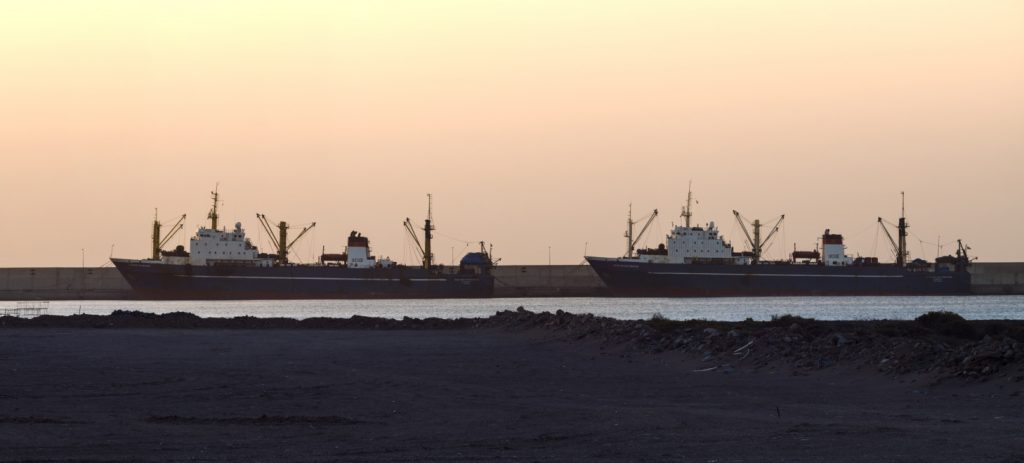
They do not allow companies from Fuerteventura to operate in Tarfaya due to the restrictions from the port of Las Palmas, and another entity is seizing that space. The presence in the southern Atlantic waters of the Russian-flagged factory ship Staryy Arbat (IMO registration 8721064, with a total length of 104.5 meters and a beam of 16.03 meters) coincides with a historic upturn in the industrial performance of the port of Tarfaya. Official data collected by the Moroccan National Fisheries Office (ONP) confirm that the landings of coastal and artisanal fishing at this strategic infrastructure have surged by 49% in the first four months of 2026. The total volume marketed climbed to 14,691 metric tons by the end of April, compared to 9,889 tons recorded in the same period the previous year.
The volumetric leap has had an immediate financial impact on the local economy, boosting the overall revenue of the Tarfaya fish auction. The market valuation of these catches reached 19.65 million euros, a net increase of 28% compared to 15.37 million a year earlier. This local performance contrasts with the national industry trend, where landings from coastal and artisanal fleets fell by 5% year-on-year (195,828 tons), although the market value across the entire kingdom increased by 5% to surpass 360.98 million euros.
Values converted to euros according to the official closing exchange rate
The main engine of port growth is situated in the segment of pelagic fish (sardines, mackerel, and horse mackerel), recurrent target species for industrial fleets operating under specific agreements in the region. Pelagic landings increased by 70% to reach 12,047 tons, injecting 5.71 million euros into the port’s accounts, a surge of 112% compared to the 2.69 million euros billed in the previous cycle. The niche for cephalopods, led by octopus and squid, maintained its position as the largest gross revenue generator, contributing 11.08 million euros from 1,367 tons commercialized, a sustained growth of 6% in volume and 9% in accounting value.
The expansion of Tarfaya’s fishing grounds, however, reveals imbalances in high-value commercial fisheries. Landings of white fish experienced a 15% decline in volume, dropping from 1,490 tons to 1,268 tons, although supply tensions raised their unit prices at auction to 2.84 million euros (a 13% increase in monetary terms). The most severe drop was recorded in the crustacean division, whose volume fell by 67%, consolidating barely 9 tons, which drastically reduced the income of the artisanal fleet from 48,700 euros to only 17,800 euros by the end of the analyzed period.
The strategic anchorage of the Staryy Arbat in Tarfaya underscores the renewed logistical weight of the port enclave, located at the northern border of Western Sahara and opposite the Canary fishing grounds. State investments in the modernization of Moroccan docks and the renewal of exploitation agreements with foreign shipowners have transformed the Tarfaya bay into a key processing node for the Russian fleet and local operators, consolidating a fishing corridor that alters supply balances in the African Atlantic basin.







