




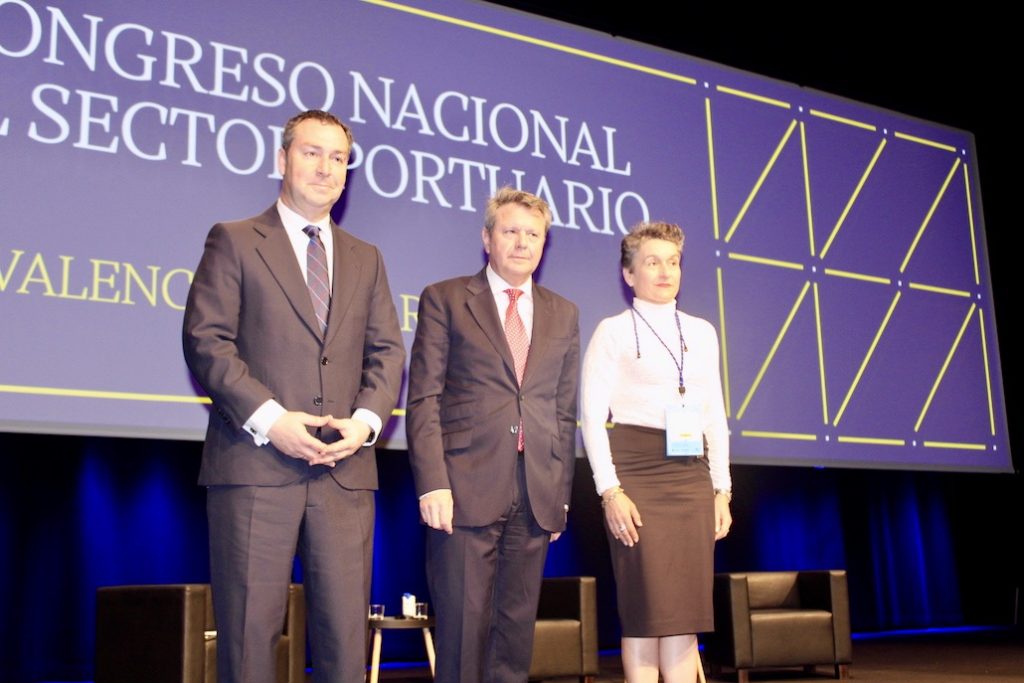
Ports and Shipping details this week a truth with all logic: The National Port Congress in Valencia unfolds as an obscene simulation of vitality, a succession of photocalls and canapés where touristic fanfare hides the emptiness of an institution that only aspires to its own inertia. At the center of this shadow theater emerges Gustavo Santana, a Easter Island Moai carved in the Canary quota of Oscar Puente, whose only merit is an imperturbable hieratism that allows him to deny, with a marble half-smile, the controlled demolition of the state system.
As the hallways of luxury hotels vibrate with the murmur of amendments from ERC, Junts, and the PNV—this ticking time bomb that seeks to transform ports into an ‘port Ibex’ free from the oversight of IGAE and binding reports—, Santana remains frozen, oblivious to the coup brewing in the Congress of Deputies. It is the definitive victory of institutional tourism over real politics: a world where figures like Carbonell laugh last and the strategic ‘goodism’ of Rodríguez Dapena, a member of the board of Ports of Las Palmas, dissolves in the privatizing stench that seduces both the Nadal boys and a clueless left, while port sovereignty fragments into merchant societies ready to play Monopoly with public space, all under the radar of a society too tired to notice that its horizon is being stolen.
In the past New Economy Forum, Gustavo Santana, ‘that Moai of the Canary quota, has perfected the art of nonexistence. When questioned about port autonomy, he responded with the placidity of a stone bust that has not noticed any pressure, ‘except in specific cases.’ For Ports and Shipping, what is happening is a technical lie, a smokescreen floating over the administrative desert. Since December 4, amendments 106, 135, and 193—surgically signed by ERC, Junts, and the PNV—rest in the Official Bulletin of the Cortes Generales as a death sentence for the state system.
Santana pretends that nothing has happened under his radar, but the text is explicit: a ‘special autonomy’ is demanded for Barcelona, Bilbao, or Tarragona, which would grant them their own statute where the reports from Ports of State would become mere ‘suggestions that are potestative and non-binding.’ ‘The plan is an assault on total management: the capacity to play stock market Monopoly with merchant societies, freedom to invest without the permission of the Council of Ministers, and the elimination of the ‘ladies of the IGAE’ and their annoying fiscal controls. While Santana cultivates his paschal hieratism, the Spanish port system fragments into a peripheral Ibex of ‘real estate windfalls’ and financial autarky, a process of decomposition that he prefers not to feel or suffer, while the Congress of Deputies liquidates, paragraph by paragraph, the last trace of administrative unity that we had left.







