




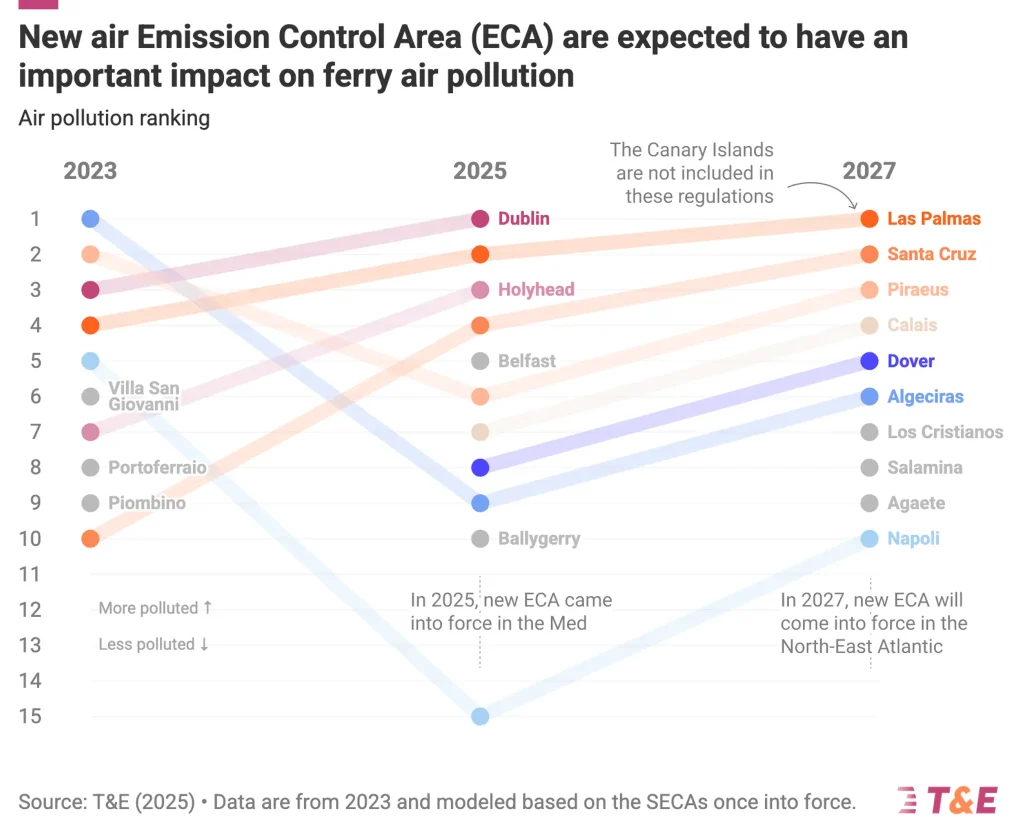
The Port of Las Palmas is approaching a turning point that threatens to redefine its competitive position in the Atlantic. According to the latest report from the organization Transport & Environment (T&E), the capital of Gran Canaria is projected to become the most polluted ferry port in Europe by 2027. Bosco Serrano, head of sustainable fuels at T&E Spain, stated: ‘Ferries should connect communities, not pollute them. Too many ferries burn polluting fossil fuels, emitting toxic air to Europe’s port cities. Electrifying them could drastically reduce emissions and bring a breath of fresh air to millions.’
This rise in toxicity ranking is not due to an organic increase in traffic but rather to a regulatory shift: while nodes like Dublin—currently the leader in emissions—or Barcelona will see their impact mitigated by the implementation of new emission control areas (ECA) in the Northeastern Atlantic and the Mediterranean, Las Palmas’s dependence on an aging fleet will expose the environmental vulnerability of the archipelago.
The magnitude of the challenge is measured in an arithmetic comparison that questions the sustainability of the current model. The 1,043 ferries analyzed by T&E emitted 13.4 million tons of CO2 in the last financial year, a figure equivalent to the impact of 6.6 million cars. In high-density ports like La Luz and Las Palmas, these vessels produce a load of sulfur oxides (SOx) that exceeds the total emissions from the urban vehicle fleet. The problem is structural: the average age of the European fleet is 26 years, a seniority that in the Canary Islands, where ferries are an essential service for connectivity, translates into an uninterrupted burning of heavy fossil fuels close to major population centers.
However, the T&E report identifies a window of opportunity based on cost efficiency. It is estimated that 60% of European ferries could be electric by 2035, and most relevant for the financial balances of shipping companies: 52% of these routes would be more profitable to operate with batteries than with internal combustion engines. The competitive advantage of electrification is particularly high on the inter-island routes in the Canary Islands due to their fixed trajectories and predictable distances. The necessary infrastructure does not represent an insurmountable technological barrier; 57% of European ports would only require chargers of less than 5 MW to support these clean operations.
For the Canary Island port authorities, the transition has ceased to be a matter of corporate responsibility and has become a commercial survival priority. With the current fleet on the brink of its technical retirement, the capital port faces a strategic dilemma: to lead investment in onshore power supply (OPS) systems and vessel renewals, or to bear the reputational cost and potential penalties of holding the title of the most polluted port on the continent in just twelve months.







