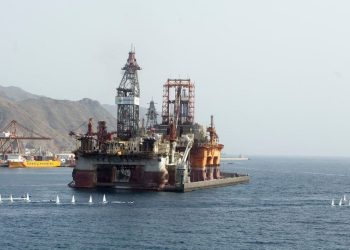
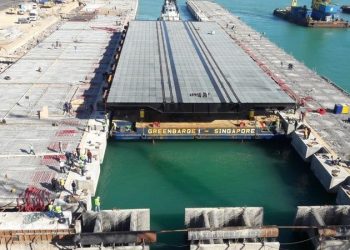
In the geoeconomics of global shipping routes, position is not everything; industrial support capacity determines who captures the added value of ocean traffic. The commissioning of the Hidramar Ultra 22000 floating dock at the Port of Santa Cruz de Tenerife represents more than the launch of infrastructure costing €40.7 million; it addresses a historic strategic deficit in the mid-Atlantic. However, the divide between the vision for defense and the shipbuilding industry and the tangle of local politics became clear at the very moment of its inauguration.
The end of the bottleneck in the Panamax segment
The asset, capable of docking vessels of up to 180 meters in length and 22,000 tonnes of displacement—doubling the archipelago’s previous operating capacity—allows the islands to compete in the Panamax segment for the first time. In terms of naval logistics and technical support for merchant fleets and maritime supply operations, the infrastructure closes the gap that forced shipowners to divert their vessels to shipyards in northern Europe or the Mediterranean for dry-dock hull and propulsion repairs. For a region located at the crossroads of the sea lanes linking Europe, Latin America and West Africa, the lack of this resource represented an unsustainable competitive vulnerability.
Logistical passage through global chokepoints
The project’s scale and operational journey sum up the complexity of today’s maritime landscape. The dock reached the Canary Islands after an almost two-month voyage from China, sailing amid geopolitical tensions in the Red Sea and the Suez Canal, exacerbated by instability in the Middle East. The logistical complexity of moving a structure measuring 240 meters in length and 48 meters in beam through global chokepoints was compounded by a bureaucratic labyrinth: an 11-year sequence of administrative procedures and friction that the company’s management did not hesitate to describe as an “obstacle course.”
A rift between industrial initiative and local political power
The absence from the inauguration of the senior leadership of the Port Authority of Santa Cruz de Tenerife and the main representatives of the regional governing coalition (CC and PP) exposed the rift between the industrial sector and island political power. Jonathan Pérez, CEO of Hidramar, lashed out at what he described as regulatory “deceptions or half-truths” that have delayed the dock’s operations and constrained the project’s development.
“Along the way, there have been a lot of deceptions or half-truths that have meant the project has spent more than 11 years navigating bureaucratic procedures from that groundbreaking ceremony to today, and we still are not 100% sure that we will be able to dock a vessel next Friday,” Pérez said, pointing to the paradox of a peripheral region hindering the diversification of an economy overreliant on sun-and-beach tourism. As an example of the regulatory absurdity, the company cited the need to remove technical mooring components because of rigid procedures for granting concessions over public port space.
Industrial sovereignty and rapid-response capacity
From the perspective of industrial sovereignty and defensive logistics support, the infrastructure—financed 50% through European Union funds (ERDF) and state regional incentives—adds resilience to Spain’s port network. The company’s technical director, Rafael Rolo, highlighted the system’s operational competitiveness, which can lift a vessel in two hours, as well as the multiplier effect expected from a 130% increase in labor demand for the auxiliary boiler-making, steel and piping industries.
A test under the Spanish flag
The Hidramar Ultra 22000’s first major test will come with the docking of a Panamax vessel for a comprehensive overhaul of its propulsion systems and hull treatment, an operation estimated at €1.5 million that will employ around 600 workers. While the company is already planning a second industrial complex at the Port of Granadilla with capacity for nine vessels simultaneously, the Santa Cruz de Tenerife dock is beginning operations under the Spanish flag. The infrastructure demonstrates that, even in hostile bureaucratic environments, private initiative and European co-financing can deliver critical industrial capacity at a point of high geostrategic value.
The article Pestana highlights the Canary Islands’ drive for industrial sovereignty as Tenerife’s Hidramar Ultra dock begins operations was first published on canarymaritime.com.