




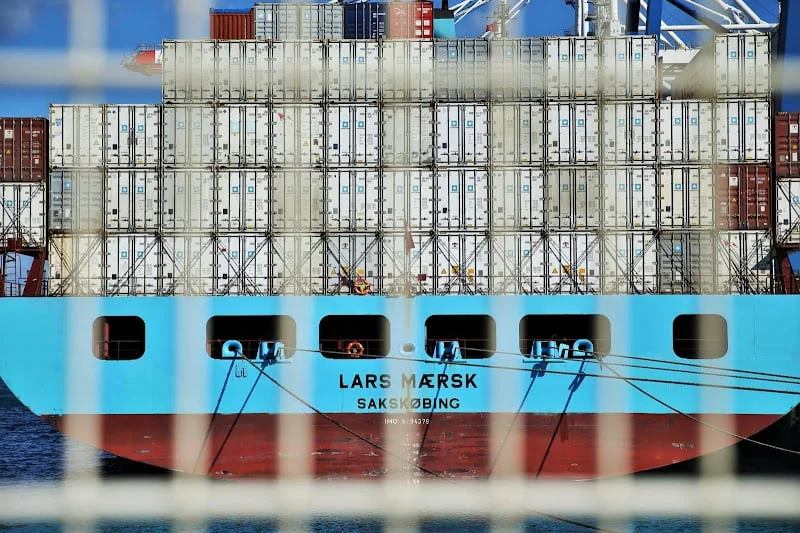
Only a 10-degree turn is needed. The logistics landscape of the Central Atlantic is undergoing a tectonic shift, the consequences of which will be felt strongly at the Port of La Luz and Las Palmas, where MSC has a terminal with TIL Group. AP Moller Capital, the asset manager of the Danish group AP Moller-Maersk, which manages a key terminal in Algeciras and Tangier Med, has announced the definitive closure of an investment fund of 243 million dollars intended exclusively for the transport and infrastructure sector in Morocco. This is to inject money into Dakhla Atlantique.
This maneuver, financially backed by the Mohammed VI Investment Fund, is not an isolated investment, but rather a strategic move that places the Canary Islands in an unprecedented competitive vulnerability. The cost of labor in the Canaries is daunting for operators: 8,800 euros per month in wages have the dockworkers, who have a social protection framework inherited from the dictatorship of General Franco.
Although the announcement focuses on private investment in Moroccan territory, the international logistics sector is closely monitoring the evolution of Dakhla Atlantique. The mega-port being constructed by Rabat on the shores of Western Sahara aims to become the reference hub for trade between West Africa, America, and Europe.
With the 243 million dollars recently raised, Maersk reinforces its commitment to the alawite kingdom. The fund will invest in cold storage, air cargo handling, and third-party logistics, services that until now had been the comparative advantage of the Canary ports due to their legal security and European connectivity.
Kim Fejfer, CEO of AP Moller Capital, has been blunt: ‘Morocco represents a priority market due to its strong economic fundamentals and sustained investment in infrastructure.’ This declaration of intent leaves the Canaries at a crossroads. While the port of Las Palmas struggles with saturation and European operational costs, Morocco offers an aggressive, modern logistics platform backed entirely by the global transport giants.
The ability of AP Moller Capital to attract institutional capital (178 million dollars from Moroccan investors and 65 million direct from the Danish firm) demonstrates that the private sector blindly trusts the Rabat-Dakhla axis. Maersk’s entry into the internal logistics fabric of Morocco will facilitate the absorption of goods traffic that currently scales in the Canaries for ‘technical security’ into the new crown jewel of Morocco in the Atlantic. Morocco no longer only exports agricultural products; now, alongside Copenhagen, it exports logistical efficiency. The challenge for the Canaries is no longer in the future: it has landed with a check for 243 million dollars.







