




The maritime board of the Canary Islands moves in silence, but with weighty figures. The group of island companies is negotiating to be the Canarian leg when Naviera Armas becomes history, formed by large beneficiaries of transport aid financed by the European Commission, tax incentives, and scattered funds. Specifically, they amount to 18.7 million euros. This is not a minor operation. It effectively means that strictly Canarian capital is trying to gain space in a strategic sector: interisland transport and connections with the mainland that are subsidized by the EC.
A violent market
Is this a purchase operation boosted by money from Brussels? Unless the EC and the CNMC monitor how these transport aids are paid and whether they generate a distortion in favor of an operator of which they are shareholders, it is presumed that it is not. For Adolfo Utor, president of Baleària, the market in Spain is friendly. Last January he stated that companies ‘come and go from the lines with absolutely dizzying dynamism, where there is real competition.’ The owner of Baleària wants Naviera Armas (owner of Trasmediterránea) to face Fred Olsen in the islands with a deeply rooted agenda but without excessive passions. It must be noted that ‘there will be more competition when the decision comes to light.’ This is about executing a plan to gain advantages and control data, not about seeing a minor product from Dinosol on Utor’s ships with bottles of rum or private label perfumes from Fund Grube.
The digital kit of poor Jucarne
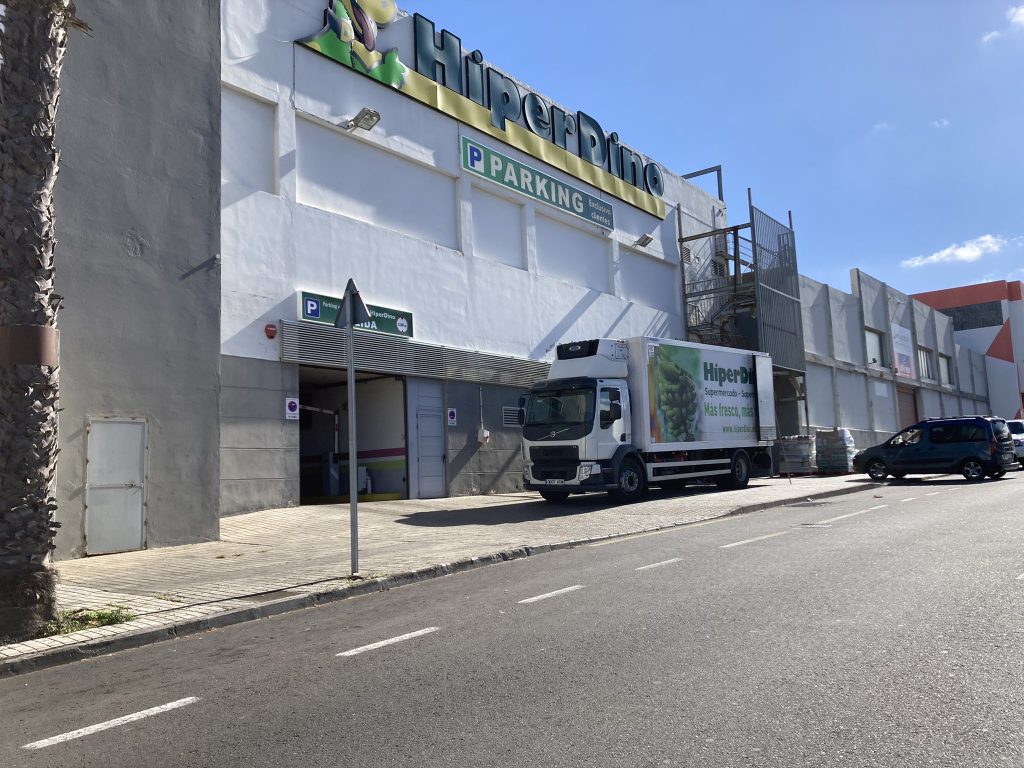
The majority of the public money received by the pool of island companies opting to participate in the operation falls to Dinosol Supermarkets, which receives 10.6 million euros. Following them are Destilerías Arehucas, with 2.6 million euros. The intermediate block is completed by Fund Grube, with 2,367,508 euros, and Aguas de Firgas, totaling 2.2 million euros. Both companies represent different sectors —perfume and large-scale tourism distribution in one case, food industry in the other— but share the same logic: to ensure the flow of goods.
In a second financial tier are Jucarne, with 614,780 euros; Acosta Matos, which receives 186,518 euros; Ahumados Canarios, with 68,000 euros; and Teocali (Jucarne), which has secured 6,000 euros to make its website more operational with a digital kit. Modest amounts, but they complete the picture of a transversal alliance: food, industry, trade, and territorial brand. The total amount received is 18.77 million euros.
The potential acquisition of part of Baleària’s business in the Canary Islands is not just a corporate transaction. It is a strategic pulse. Maritime transport in the Archipelago is critical infrastructure: it moves tourists, supplies supermarkets, supports exports, and connects eight islands that depend on ships as the economic backbone. Controlling it, even partially, equates to gaining influence over the logistical rhythm of the territory. In a context of growing competition on Atlantic routes and pressure on energy and regulatory costs, the entry of Canarian capital into the sector could reconfigure balances. It is not only about numbers. It is about who decides, from where, and with what priorities, the future of maritime traffic in the islands.
News written by Pedro Marrero. Edited and verified by José L. Jiménez. Cross-referenced information without institutional filters. This analysis has not been funded by official advertising nor conditioned by lobbying interests.







