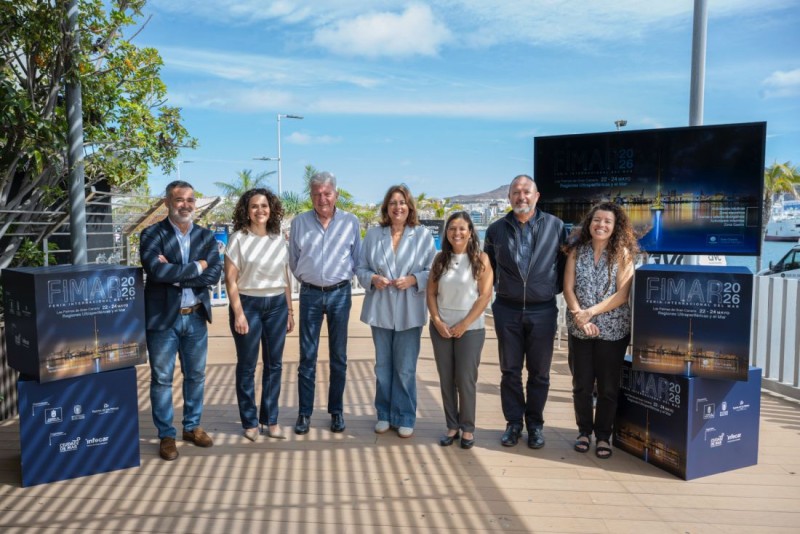
The capital of Gran Canaria is preparing to transform its urban landscape into the epicenter of the blue economy. From May 22 to 24, the Sanapú dock will host the fifteenth edition of Fimar, an edition that transcends its exhibition character to become a tool for attracting human capital. Presented by Pedro Quevedo, councilor for the City of the Sea; Beatriz Calzada, president of the Port Authority; Natalia Santana, director of Infecar; and Daura Vega, representative of ULPGC, the fair aims this year to close the gap between the technical demands of port companies and the training of young Canary Islanders.
The Port Authority of Las Palmas has been explicit in its strategy change for 2026. Its institutional stand will not be limited to promoting infrastructure but will function as a job guidance office. Beatriz Calzada emphasized the critical need for qualified personnel to emerge from the region itself, focusing Fimar as the ideal setting to explain the professional opportunities in a port environment that increasingly requires greater technical specialization. This shift responds to a market reality: the Port of Las Palmas is a job engine that requires a smoother connection with citizens to maintain its global competitiveness.
The RUP Factor and Transatlantic Connection
Under the theme of the Outermost Regions (RUP), Fimar 2026 elevates its diplomatic and commercial reach. The participation of Martinique as the first invited territory from across the Atlantic is not merely symbolic. Both regions share the challenges of remoteness and dependence on the sea, which has crystallized into a parallel technical day on May 21 at the high-tech marine-maritime incubator of the Port. The goal is to accelerate marine ecotourism projects, a burgeoning sector that seeks to combine navigation with stargazing through the European project Twinned by Stars, led by ULPGC.
Pedro Quevedo highlighted the relevance of this ultraperipheral framework, noting that the recognition of the territory’s uniqueness is fundamental for urban and economic development of a ‘City of the Sea’. In a context of growth in the blue economy, integrating the port into the daily lives of citizens is a political priority that Fimar has successfully managed for three decades. The presence of around fifty companies and academic entities at Sanapú confirms that the fair is already a pillar of the economic diversification strategy of the Cabildo de Gran Canaria and the city council.
Knowledge Transfer and Outreach
The University of Las Palmas de Gran Canaria (ULPGC) will play a decisive role in transferring innovation to the productive sector. With 26 outreach talks led by young pre-doctoral researchers, the academic institution aims to translate technical knowledge into accessible language for new generations. Daura Vega emphasized that Fimar offers a unique opportunity to harness the potential of classrooms and show students the real opportunities provided by the port business fabric, often unknown to the average student.
In addition to the professional component, the fair maintains its appeal for the general public with traditional boat rides on the water surface of the Port, accommodating up to 130 people per trip. The program is complemented by children’s play areas, gastronomy, and live music, while maintaining free access as a way to maximize social impact. Thus, Fimar 2026 presents not only as a trade fair but as an exercise in economic sovereignty based on the sea, where local talent and international cooperation shape the roadmap for the blue economy of the 21st century.