
Saturday, 17 October 2026
  • Login
  • Español
  • English
Suscribirme
Subscribe
canarymaritime.com
No Result
View All Result
  • Home
  • Atlantic Ports
    • Atlantic Africa
  • Blue Energy
  • Logistic
  • Shipbuilding Industry
    • Shipyards and Ship Repair
    • Offshore and platforms
    • Industrial innovation and naval R&D
  • Blue Economy
    • Investment and European Funds
    • Financial Sustainability
    • Private Venture Capital
  • Atlantic Geopolitics
    • West Africa
    • Port Security and Defense
    • Blue Diplomacy
    • Canary Islands as a strategic hub
    • Drug Trafficking
  • Home
  • Atlantic Ports
    • Atlantic Africa
  • Blue Energy
  • Logistic
  • Shipbuilding Industry
    • Shipyards and Ship Repair
    • Offshore and platforms
    • Industrial innovation and naval R&D
  • Blue Economy
    • Investment and European Funds
    • Financial Sustainability
    • Private Venture Capital
  • Atlantic Geopolitics
    • West Africa
    • Port Security and Defense
    • Blue Diplomacy
    • Canary Islands as a strategic hub
    • Drug Trafficking
  • Español
No Result
View All Result
canarymaritime.com
es Español en English
No Result
View All Result
Home Blue Economy & Finance Financial Sustainability

In Las Palmas, they pray for offshore wind energy in port land: Places in the world where it is hated

José Luis Jiménez by José Luis Jiménez
9 March 2026
in Financial Sustainability
Reading Time: 3 mins read
0
60
SHARES
374
VIEWS
Compartir en WhatsappCompartir en LinkedIn
Google CONVIERTE CANARYMARITIME EN FUENTE DE NOTICIAS EN GOOGLE

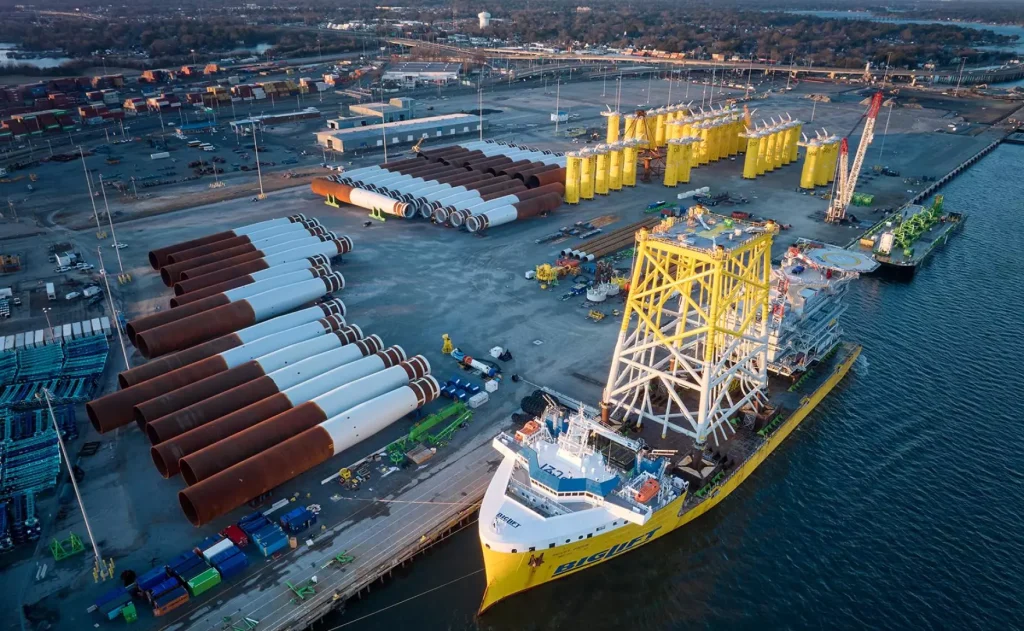
The same ones who wanted a hub for the pelagic fleet in the Canary Islands now pray, in an orthodox rite, with offshore wind energy but with reflections from the **Castilian Conquest of America**. The port of Las Palmas is caught in **a marine bubble from foreign capitals that want to place these devices on regulated land with funding from Brussels**. Ignorance on the subject is generating mantras like that the Canary Islands have a future with these elements. **Foreign promoters are leading the idea that in the Canary Islands it is an industrial business when it is actually financial**. The coexistence between traditional port infrastructure and the ambition for offshore wind energy has ceased to be a theoretical synergy to become a battlefield of spatial priorities. In the hallways of port authorities, from the coast of New Jersey to the North Sea, green optimism is clashing with the physical reality of the docks and the resistance of local communities.

In the port of **Portsmouth, Rhode Island**, the financial reality has forced a technical pause. Offshore wind energy is not a conventional load; it is an industry of **’heavyweight’ components**. A single assembly of nacelles and blades requires load-bearing resistance on the dock that multiplies five times that of a standard container terminal. For many medium-sized ports, the dilemma is existential: invest hundreds of millions in reinforcing docks for a wind sector that signs usage contracts for 10 years, or **maintain flexibility for cargo trade that guarantees income for decades**. This ‘opportunity cost’ is **paralyzing tenders in secondary ports that cannot afford a failed bet**.

On December 22, 2025, the U.S. energy sector received a seismic impact. The Department of the Interior issued immediate suspension orders (Stop-Work Orders) for five of the largest wind projects under construction, including Vineyard Wind 1 and Empire Wind. The official argument: **’national security risks’ due to the interference of giant blades with defense radars and vulnerability to underwater drones**.

In the ports of **New Bedford and New London, the effect has been catastrophic**. Critical components that were supposed to leave for offshore have been stranded at the docks, blocking general cargo areas and generating losses of up to 2.3 million dollars daily per project. The paralysis has made it clear that the growth of wind energy could mortgage the operability of a port if the regulatory framework changes overnight.

In the northeast U.S., the ambitious plan to turn Sears Island into **Maine’s main floating wind hub has run aground in 2025**. The conflict here is a ‘crossfire’ among three fronts: The Penobscot Nation and local activists have pushed for laws to extend conservation protection to the entire island, blocking any industrial development, opponents demand that the port be moved to Mack Point, an already industrialized area, but the Maine Department of Transportation maintains that **Mack Point does not have the technical capacity needed for next-generation turbines**. The financial blow at the end of 2024 came when the federal government denied a 456 million dollar grant for the project, leaving the port’s growth in a legal and financial limbo that continues until 2026.

On the other side of the world, in **New South Wales, the giant BlueFloat Energy announced its official withdrawal from the Illawarra wind project in January 2026**. The social pressure was unbearable: more than 14,000 public objections, with 65% of the community against it. Residents of Wollongong and users of the Port of Kembla reported that **the 268-meter tall turbines (equivalent to floating skyscrapers) would not only ruin the tourist horizon but also create a bottleneck for the safe navigation of commercial ships**. The port, vital for the export of coal and steel, could not afford exclusion zones that complicated entry maneuvers on stormy days.

At the **Port of Albany, the project to build the first wind tower factory in the U.S. has faced a cost increase that borders on the absurd**. What started as **a 350 million dollar project has skyrocketed above 700 million**. The root problem is the soil: to support the towers, the port has had to dredge and fill land with over one million tons of rock to create an ‘environmental’ and structural layer. This level of investment has led other traditional logistics operators to wonder whether the port is becoming a ‘wind monoculture’ that, with any political swing, could leave the facility’s finances in the red.

The trend for the remainder of 2026 is port realism. Ports are beginning to demand that wind projects be located on artificial islands or platforms far away so as not to interfere with the growth of container terminals, which remain the **golden goose of global trade**.


Google CONVIERTE CANARYMARITIME EN FUENTE DE NOTICIAS EN GOOGLE
Tags: Portada
Previous Post

Video, Naranjo (Romeu): “Dockworkers can earn up to 130,000 euros a year in Las Palmas”

Next Post

The radar veto threatens to sink offshore wind energy in Granadilla, Tenerife

José Luis Jiménez

José Luis Jiménez

Trained in the rigorous school of economic journalism and seasoned in newsrooms where truth and pressure are valued equally, he has developed a persistent distrust of rhetoric. He is not a hunter of headlines—though he once was—but a reader of documents; someone who prefers verified data to quick applause, context to noise. There is something of both cartographer and prosecutor in his writing, perhaps stemming from a humble background in Law: he maps the contours of power, but also interrogates them.

NewsRelated

Puertos Canarios abre al público sus recintos para potenciar el valor del dominio público marítimo
Financial Sustainability

Puertos Canarios clarifies scope of TSJC ruling on Puerto Rico and rules out extending concessions

16 October 2026
273
Santana se proyecta hacia la lista de Ángel Víctor Torres con el PSOE por Las Palmas
Financial Sustainability

Gustavo Santana left off PSOE’s Las Palmas lists and, for now, remains at the helm of Puertos del Estado

16 October 2026
307
Lavinia lleva su batalla contra Hacienda ante el Tribunal Supremo
Financial Sustainability

Spain’s Supreme Court to rule on port concession extensions and their impact on Laskaridis’ business in Las Palmas

16 October 2026
309
Votorantim logra una prórroga de 15 años en el Puerto de Tenerife capital para ampliar su planta de Clinker
Financial Sustainability

Votorantim secures 15-year extension at Tenerife’s capital port to expand clinker plant

16 October 2026
274
Impacto en sector del congelado en Canarias: Oleada de inspecciones sobre el cartón ondulado
Financial Sustainability

Impact on the Frozen-Food Sector in the Canary Islands: Wave of Inspections Targeting Corrugated Cardboard

15 October 2026
272
Lucasiñas asume el control de Ignauro en Canarias tras la compra de la cuota de los March
Financial Sustainability

Lucasiñas takes control of Ignauro in the Canary Islands after acquiring the March family’s stake

15 October 2026
280

Leave a Reply Cancel reply

Your email address will not be published. Required fields are marked *

© 2026 canarymaritime

  • Contact
  • Transparency
  • Code of ethics
  • Legal Notice
  • Privacy Policy
  • Cookie Policy (EU)
  • Intellectual Property Rights
  • Promise to Our Readers
  • Principles on the Use of AI
  • Commitment to Our Subscribers and Advertisers
  • Español
  • English
Gestionar consentimiento

Para ofrecer las mejores experiencias, utilizamos tecnologías como las cookies para almacenar y/o acceder a la información del dispositivo. El consentimiento de estas tecnologías nos permitirá procesar datos como el comportamiento de navegación o las identificaciones únicas en este sitio. No consentir o retirar el consentimiento, puede afectar negativamente a ciertas características y funciones.

Funcional Always active
El almacenamiento o acceso técnico es estrictamente necesario para el propósito legítimo de permitir el uso de un servicio específico explícitamente solicitado por el abonado o usuario, o con el único propósito de llevar a cabo la transmisión de una comunicación a través de una red de comunicaciones electrónicas.
Preferences
The technical storage or access is necessary for the legitimate purpose of storing preferences that are not requested by the subscriber or user.
Estadísticas
El almacenamiento o acceso técnico que se utiliza exclusivamente con fines estadísticos anónimos. Sin un requerimiento, el cumplimiento voluntario por parte de tu proveedor de servicios de Internet, o los registros adicionales de un tercero, la información almacenada o recuperada sólo para este propósito no se puede utilizar para identificarte. The technical storage or access that is used exclusively for anonymous statistical purposes. Without a subpoena, voluntary compliance on the part of your Internet Service Provider, or additional records from a third party, information stored or retrieved for this purpose alone cannot usually be used to identify you.
Marketing
The technical storage or access is required to create user profiles to send advertising, or to track the user on a website or across several websites for similar marketing purposes.
  • Manage options
  • Manage services
  • Manage {vendor_count} vendors
  • Read more about these purposes
Ver preferencias
  • {title}
  • {title}
  • {title}
No Result
View All Result
  • Home
  • Atlantic Ports
    • Atlantic Africa
  • Blue Energy
  • Logistic
  • Shipbuilding Industry
    • Shipyards and Ship Repair
    • Offshore and platforms
    • Industrial innovation and naval R&D
  • Blue Economy
    • Investment and European Funds
    • Financial Sustainability
    • Private Venture Capital
  • Atlantic Geopolitics
    • West Africa
    • Port Security and Defense
    • Blue Diplomacy
    • Canary Islands as a strategic hub
    • Drug Trafficking

  • Login

© 2026 canarymaritime.com



