“To compete with the ports of the Canary Islands.” That is the message of the promotional campaign for the new dry dock in Takoradi, funded by the United Kingdom. The ship repair sector in the mid-Atlantic is facing a definitive strategic shift that directly threatens the dominant position of Las Palmas and Santa Cruz de Tenerife. Every day of delay means 18 months lost; the maritime business is extremely cutthroat, and ship repairs are not like taking a Seat 600 to a garage to have its oil filter checked.
On Monday, the British government confirmed the financial close of the Shiprite project at the port of Takoradi, Ghana, backed by $137 million in funding. It will provide the first commercial-scale repair facility in the Gulf of Guinea. The infrastructure is entering the construction phase following the recent launch in Dakar, Senegal, of the shipyard promoted by the Damen naval group, consolidating the expansion of technical capacity along Africa’s maritime coast. The Tenerife project has remained stalled since April.
Ghana’s official statement says: “Once built, vessels of up to 200 metres in length will be able to carry out mandatory dry-dock repairs and other ad hoc repairs, eliminating the need to sail for 10 to 14 days to Walvis Bay, Namibia, or Las Palmas, Spain, for maintenance. The shipyard will also offer upgrades and other modifications to improve energy efficiency, as required in line with the maritime sector’s energy transition.”
Technical capacity for 200-metre vessels and the diversion of ocean traffic
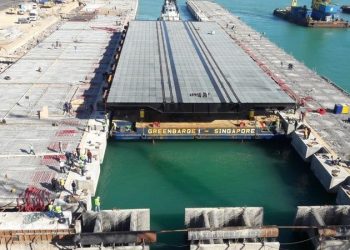
The 25-year concession awarded by the Ghana Ports Authority (GPHA) to local company Prime Meridian Docks (PMD) includes the installation of a floating dock with a lifting capacity of 13,500 tonnes and an adjacent 200-metre quay. Contractor China Harbour Engineering Company (CHEC) will begin work imminently. The project includes dredging 300,000 cubic metres of rock from the seabed to accommodate container ships, bulk carriers, tankers and offshore platforms. Once the complex enters service, commercial fleets will no longer be forced to sail an additional 10 to 14 days to Walvis Bay, Namibia, or Las Palmas to undergo mandatory dry-docking and structural repairs.
A $137 million multilateral alliance backed by pension funds
The Ghanaian shipyard’s economic viability has been structured through a complex multilateral financing arrangement led by InfraCo—part of the Private Infrastructure Development Group (PIDG)—and ARM-Harith Infrastructure Fund. The financial package combines senior and subordinated capital provided by the African Export-Import Bank (Afreximbank), the African Development Bank (AfDB), the Trade and Development Bank (TDB), and local funds Petra Pension Schemes and Origen Private Debt Fund. German consultancy Sellhorn Ingenieurgesellschaft will oversee the project, while British company Rigmar Services will manage operations during the operating phase.
Tenerife blocked as the Gulf of Guinea logistics corridor takes shape
Operational progress along Africa’s west coast contrasts with the paralysis affecting the ship repair project at the port of Santa Cruz de Tenerife. The facility’s administrative concession remains bogged down in institutional procedures while regional competitors secure financing for their infrastructure. The promoters of the Takoradi project estimate that the facility will create 430 direct jobs, capture demand generated by vessels being diverted around the Cape of Good Hope, and prevent the annual emission of 180,000 tonnes of CO2 by shortening technical voyages for the transatlantic fleet.
The article Ghana Launches Floating Dock to Compete with Canary Islands Shipyards as Tenerife Project Stalls was first published on canarymaritime.com.