The Canary Islands are consolidating their status as an essential technical stopover for deepwater exploration giants. Market analyst Esgian reports a global revival in the hydrocarbons industry marked by three strategic developments: the consolidation of drilling fleets in the Middle East, the search for new reserves in the Caribbean basin, and the redeployment of next-generation vessels to the waters off West Africa. Within this maritime flow structure, the Canary Islands’ geographic position and industrial infrastructure act as a magnet for the international fleet’s highest-value units.
ADES expands its presence in the Saudi Arabian market
Advanced Energy Systems has completed the acquisition of the fleet of jackup rigs that Italy’s Saipem operated in Saudi Arabian waters. The addition of five operational units strengthens the company’s control over one of the world’s busiest and most profitable offshore drilling markets.
Following the agreement, ADES manages a portfolio of 128 drilling units, comprising 88 offshore rigs and 40 land rigs. The deal confirms a sustained trend in the offshore sector: the concentration of shallow-water assets in the hands of highly specialized operators capable of reducing operating costs through economies of scale in regions with mass production.
The Santorini’s technical stop before Côte d’Ivoire
The move with a direct impact on the islands’ shipyards involves the seventh-generation drillship Santorini, which is also part of Saipem’s fleet. After completing its work in the Mediterranean, the vessel is sailing to the Port of Las Palmas, where it is scheduled to arrive at the end of September.
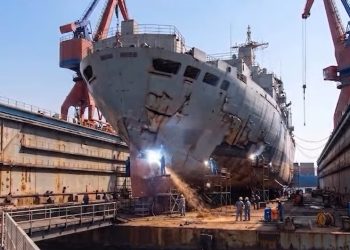
The vessel will berth in the capital to undergo a Special Periodic Survey (SPS) and carry out the modifications required for its next contract in Côte d’Ivoire. Italy’s Eni has awarded the Santorini a development campaign in Ivorian waters worth approximately $260 million. This commitment removes one of the world’s most advanced drilling units from the open market.
The choice of the Canary Islands for this technical stop reflects the availability of skilled auxiliary industries capable of working on highly complex naval-industrial structures. The Santorini, built to the Samsung 12000 design, operates in water depths of up to 3,500 metres (12,000 feet).
The vessel has two complete seven-cavity Blowout Preventer (BOP) systems, the highest specification for ultra-deepwater operations. This duplication of equipment allows maintenance work to be carried out on one of the safety systems without interrupting activity on the seabed. The vessel also features the NOVOS platform, an automation system that mechanizes repetitive drilling maneuvers and reduces the likelihood of human error during critical tasks. The combination of development contracts in Africa and tenders in the Caribbean is keeping the availability of drillships under pressure. In this context, Las Palmas is reaffirming its role as a leading logistics hub and shipyard for the energy network of the Mid-Atlantic.
Saipem (ENI) Sends the Santorini to Las Palmas Port After Its Stint in Saudi Arabia was first published on canarymaritime.com.