




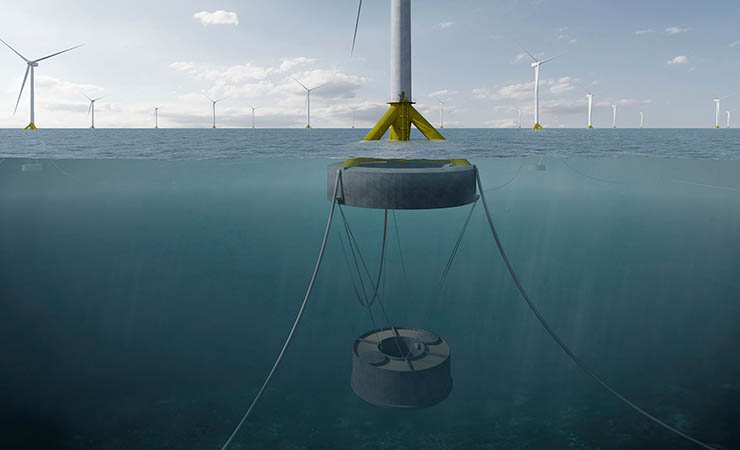
The Spanish engineering company Esteyco has launched a disruptive solution that could redefine how substructures are built offshore. Under the name Airbarge, this technology allows conventional modular pontoons to be transformed into high-precision submersible barges using simply compressed air. For the renewable market, the Canaries are not only exporting wind but are becoming the laboratory where the profitability of future offshore is designed. The issue is that there are lobbying groups that want the navigation business to be dominated by marine wind in the revenue equation, seeking protection from Brussels.
The system, detailed by Paola Romero, Project Implementation Director at Esteyco, removes complex and costly traditional water pumping systems from the equation. By managing ballasting through air, Airbarge allows millimetric control of stability during critical launching and assembly operations, drastically reducing operational risks and, most critically for investors, capital expenditure (CAPEX).
The Port of Las Palmas as a Testing Ground
The relevance of this innovation has found its first real application in the WHEEL Project (Wind Hybrid Evolution for Low-Carbon Solutions). At the docks of Las Palmas, Airbarge is being used for the construction of a 6 MW pilot unit intended for deep waters.
The WHEEL project is not just a prototype; it is a commitment from a leading European consortium to reach a pre-commercial technology readiness level (TRL). The unit will be installed and monitored at the PLOCAN test bench (Oceanic Platform of the Canary Islands), where it will be validated whether this combination of disruptive engineering can effectively reduce the Levelized Cost of Energy (LCoE) of floating wind.
Scalability and Carbon Footprint
Esteyco and its partners’ thesis is based on two pillars that concern the sector: port infrastructure and sustainability. By allowing the use of modular pontoons —which are easier to find and mobilize than large specialized submersible barges— Airbarge addresses the lack of availability of large maritime assets in secondary ports.
The design of WHEEL technology aims for a radical minimization of the carbon footprint in manufacturing and deployment. If the results at PLOCAN confirm the projections, the sector could be facing a ‘radical step’ towards the mass industrialization of marine wind energy, allowing substructures to be assembled faster, cheaper, and with less dependence on external heavy equipment.







