




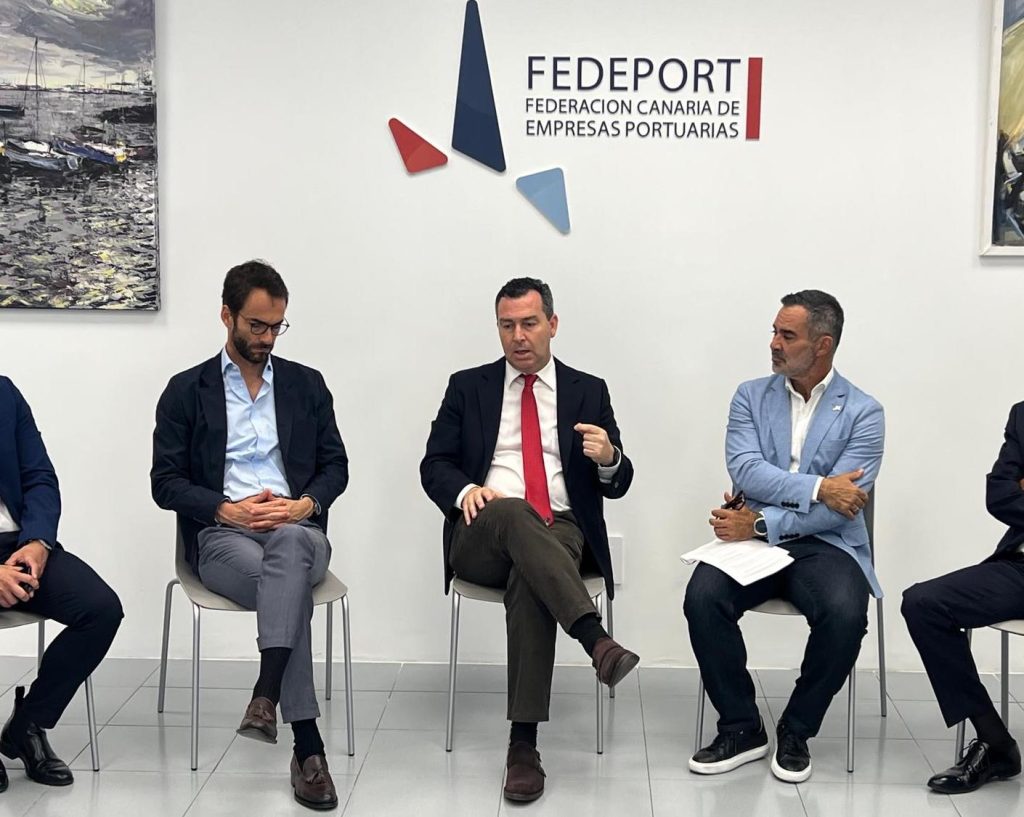
In the engine rooms where foreign capital decisions are made at the Port of Las Palmas, a new and challenging consensus is solidifying. Germán Suárez, manager of the naval repair giant owned by the Greek group Lavinia, has set a clear position for 2026: the industrial engine of the archipelago must be shielded from the ‘noise’ of regional politics. Such statements coincide with the presence in his business of a ship from the Moroccan Royal Navy, an oceanographic vessel.
In an interview on ‘El Espejo Canario’, where he was introduced as president of Astican, he supported conducting explorations in the Sahara claimed by Morocco and the sale of Boluda terminals to the Moroccan state capital, both operations questioned by the Gran Canaria Cabildo, which even requested the wind with the anti-OPAs shield understanding that due to national security it should not be in the orbit of Rabat for reasons of sensitive information affecting the defense of the island’s strategic interests.
Precarious paradox
Suárez has launched a demand for ideological immunity that would allow Canary capital to flow into ports under Moroccan control, such as Dakhla, without being labeled as ‘unfaithful’ by the local government. As the West African logistics corridor heats up, the Canary Islands find themselves in a precarious paradox. While regionalist politicians see the rise of Moroccan ports as a zero-sum threat to sovereignty, the maritime elite of the islands only sees a landscape of risks and opportunities.
‘Thinking that a family with four generations of history in Las Palmas would work against its own interests is absurd,’ said Suárez, dismissing the accusations from Antonio Morales in the Gran Canaria Cabildo. This is more than a local dispute; it is a microcosm of the global struggle between territorial politics and the apolitical nature of maritime logistics. Suárez’s message is clear: in the race to command the Atlantic, capital cannot be tied to the ideological theses of the state.
Morales’ gas
The Port of Las Palmas is a story of success derived from the Suez crisis, capturing diverted traffic and reinforcing financial balances as early as 1972 and more recently in 2025. But beneath the surface, a ‘weakness’ is oozing, according to Germán C. Suárez, chief manager of Astican. The bone of contention is Liquefied Natural Gas (LNG), which Morales, PSOE, NC, CC, PP, and the employers’ association Oneport have rejected. Since 80% of newly built ships opt for dual fuel systems, the absence of an LNG supply (bunkering) center in the Canary Islands is increasingly perceived in the industry not as an environmental choice but as a strategic failure. Suárez’s criticism of the local political class is unusually blunt: the market has already spoken, and the islands are not listening.
By framing the lack of LNG infrastructure as a self-inflicted wound, Suárez tries to depoliticize investment. However, in doing so, he raises a deeper debate about who truly controls the strategic direction of the islands’ most valuable asset: the politicians who govern by suffrage or the ‘pragmatic’ capital that commands the sea.
News written from Tenerife by Pedro Marrero. Edited and verified in Las Palmas by José L. Jiménez. Cross-referenced information without institutional filters. This analysis has not been funded by official advertising nor conditioned by lobby interests.







