




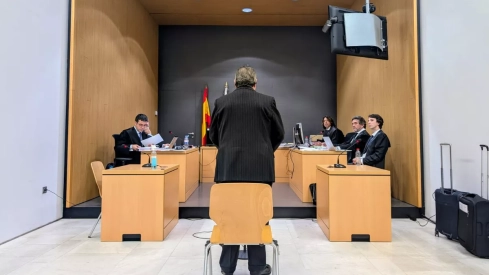
The image from the newspaper Atlántico Hoy of Vicente Boluda, seen from behind before the court in Las Palmas, serves as a perfect metaphor for an era: power does not need to look its victims in the face. After the dreadful judicial spectacle this week during Carnival, the words of Xabier Arzalluz about Josu Jon Imaz echo: we are witnessing “a bad example for the youth.” What occurred in that courtroom is the bitter lesson received by the youth of the Canary Islands: the daily observation of how an extractive and foreign capitalism takes over this land at bargain prices, crushing, if necessary, the reputation of an honest official whose only sin was trying to ensure that the Port of Las Palmas ceased being a fiefdom.
José Antonio Morillo-Velarde appeared with the weakness of someone who has spent forty years protecting the architecture of the State, only to discover that the administrative Leviathan is the first to retreat when the adversary has its own fleet. His solitude was absolute. Before him, the shipowner was not merely an accused but rather a weather system; a force of nature against which the Ports Law is merely a broken umbrella in a hurricane of interests.
In the dimness of the room, the trial transformed into an exercise of procedural tightrope walking. Professionals such as José Antonio Choclán and Jiménez de Cisneros — those legal architects who drafted the original complaint against the port leadership as if designing a shopping center on a protected wetland — appeared to explain that truth, in certain strata, seems to be a matter of interpretation and fees. With the coldness of someone operating within a system that has already collapsed, the narrative revealed an uncomfortable reality: the powerful no longer need to lie; it is enough for them to outsource the creation of a legal thesis that converts the defense of a monopoly into administrative doctrine.
While Morillo-Velarde witnessed the dismantling of his prestige with the weariness of a public servant who discovers that the State is a client that never pays the bills of honor, the defense claimed that the reported facts were “true a priori.” This is a fascinating metaphysical category: a suspended truth that only serves to feed a machinery designed for technical harassment. Honesty in the public sector thus appears as a form of functional autism; a flaw in the system that successful individuals rectify with the weight of their existence.
Ultimately, the sacrifice of public faith was staged. Morillo-Velarde, who made the mistake of believing in the law after four decades of service, faced one who has turned the ocean into a private garden. It was not just a trial for false complaint; it was a lesson in anatomy on how power devours the technician who dares to place a norm between a magnate and his profit. The result is a desert: the market freedom in the Canary Islands has died in those corridors, suffocated by the smoke of tugboats that do not allow competition. FairPlay is already gone. The monopoly has won. And the official is left only with the consolation of the defeated: knowing that, in this world, rectitude is the shortest path to humiliation.







