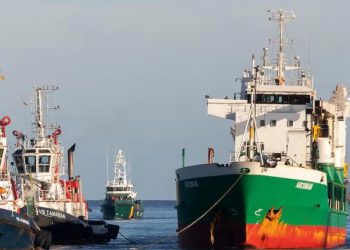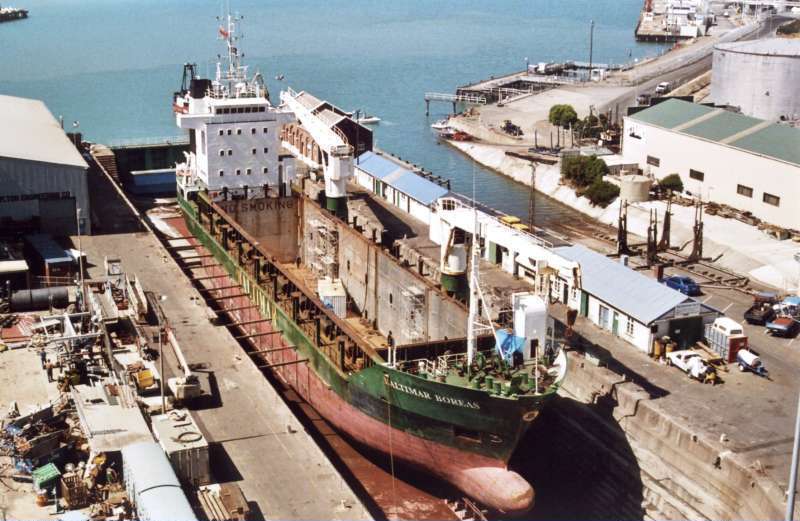
The recent interception of the vessel Arconian has exposed a sophisticated corporate architecture that directly links the financial centers of Germany and Turkey with the logistics platforms of the Central Atlantic, placing the fishing grounds and ports of the Canary Islands at the heart of a new massive drug supply route.
The analysis of the ownership and management structure of the vessels under investigation reveals an operational pattern of ‘near-shoring,’ where West Africa acts as a base for mass storage and the maritime environment of the Canary Islands serves as a critical entry corridor to the consumer markets of the European Union.
The criminal network linked to Jos Leijdekkers utilizes cross-ownership and interchangeable structures to camouflage the voyages of merchant fleets that imitate the behavior of the so-called ‘shadow fleet’ internationally, commonly used to evade geopolitical sanctions, according to a report published this June by The Global Initiative Against Transnational Organized Crime.
Commercial records detail that three key vessels in this scheme—the White Eagle, the White Labeille, and the Arconian itself—were acquired almost simultaneously by shell companies from Sierra Leone with no prior commercial history: Imperial Shipping, Diamond Line Shipping, and Serenity Shipping. Behind this African façade lie consolidated nodes that connect technical management with companies based in the Euro-Asian axis, with significant intensity in the ports of Flensburg (Germany) and Gaziantep (Turkey).
Mirror Structures and Dual Turkish-German Governance
The financial engineering of the network relies on a dual management system of a symmetrical nature. Before their formal transfer to the Sierra Leonean companies, the three vessels were registered under the ownership of three distinct German firms but domiciled at the same postal address: Landstrasse 65, in Flensburg.
These firms—Toprak Shipping Inc., Zeynep Shipping Co. Ltd, and Firat Shipping Co. Ltd—also shared the same commercial manager, the company Tunaryan Schifffahrts GmbH. The transition to Turkish control was solidified at the end of 2022, when the firm Nisa Uluslararasi Deniz, registered in the Turkish locality of Gaziantep, took over the international safety management (ISM) responsibilities for the entire fleet, establishing a unified operational control that persists into 2026.
The organization’s roots in Turkey extend to the family and financial spheres of its main subjects under investigation. Harry Leijdekkers, the brother of the network’s leader, maintained his operational base in Turkish territory until his recent arrest in May 2026, after having forged business alliances through his brother-in-law Abdullah Alp Üstün. These connections facilitated an influx of capital into the complementary naval management sector, allowing modestly sized firms like Tunaryan and Nisa to assume logistical control of strategic routes connecting the ports of North Africa, particularly Libya, with the Atlantic distribution nodes surrounding the Canary archipelago.
Canary Islands as the Frontier of New Drug Trafficking Logistics
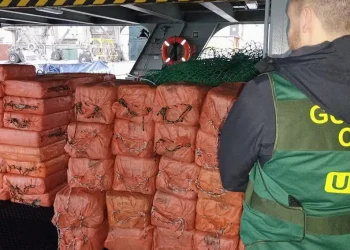
The scale of the seizures from the Arconian confirms a paradigm shift in the large-scale transport of cocaine via cargo vessels. The strategy of fragmenting shipments into traditional containers has given way to chartering entire merchant ships that carry tons of cargo from collection centers in the Gulf of Guinea to offloading points at sea near the European coast. In this new geographical arrangement, the position of the Canary Islands becomes highly coveted: the waters of the Canary fishing ground offer ideal logistical conditions for transshipping goods to smaller vessels or for covering legitimate commercial ships that modify their geolocation systems.
This massive and constant flow explains, according to Europol’s analyses included in the financial reports on organized crime, the anomalous behavior of the European market since 2024, characterized by a continued decline in wholesale cocaine prices on the continent despite a decrease in seizures at major ports such as Antwerp or Rotterdam.
The ability of the Turkish-German network to circumvent traditional customs controls through routes that avoid the main ports threatens the mechanisms of physical inspection on the islands. The strengthening of port security in Las Palmas and the monitoring of foreign capital consigning companies emerge as urgent financial priorities to dismantle a business model that has transformed the Canary Atlantic into the toll highway of major Euro-Asian mafias.