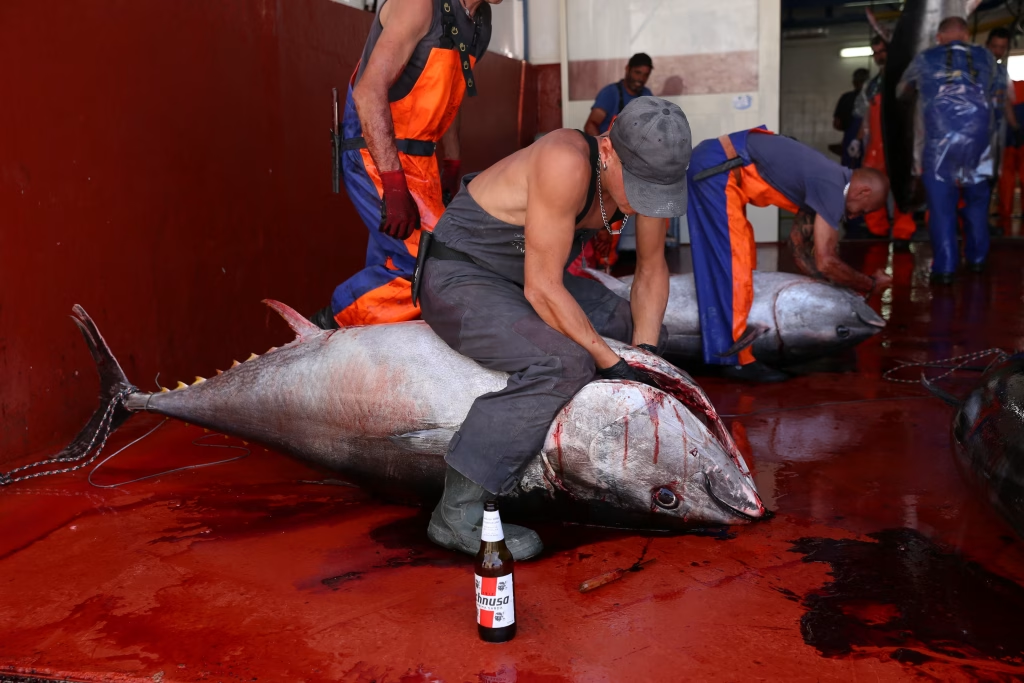
The recent Resolution of May 28, 2026, published in the Official State Gazette (BOE) this Monday, marks a turning point in national fisheries management. Under the umbrella of recommendations from the International Commission for the Conservation of Atlantic Tunas (ICCAT), Spain has consolidated its roadmap for the 2026 season, establishing a total quota of 7,938.81 tons of red tuna (Thunnus thynnus). However, the most relevant aspect for the primary sector in the islands is the regulatory validation of a pilot project aimed at transforming the potential of the Canary Fishing Ground: the implementation of an experimental program for breeding red and bluefin tuna in the waters of the archipelago.
This milestone, supported by ICCAT Recommendations 25-04 and 25-01, positions the Canary Islands at the forefront of highly specialized Atlantic aquaculture. The resolution not only details the distribution of fishing opportunities—where authorized tuna vessels in Canary waters have a specific allocation of 7.9263% of the national quota, reinforced by an additional increase of 58.70 tons—but also inaugurates a regulatory framework where industrial breeding begins to gain ground over traditional extractive fishing. This shift, under the supervision of the General Secretariat of Fisheries, underscores a strategy of ‘industrializing biodiversity’ that aims to capture greater added value in the insular production chain.
The control as the axis of the new fishing board
The resolution establishes a complex surveillance system that seeks to end impunity in the international waters near the islands. The requirement to use the Electronic Fishing Logbook (DEA) for all authorized vessels, regardless of their length, strengthens the full traceability of catches. This digital control is not trivial: the ‘Advance Notification’ system for arrival at port (PNO), with at least four hours in advance, is set as the standard for any cargo movement, a measure designed to safeguard transparency against the sustainability demands imposed by Brussels.
The technical complexity of the new Management Plan also extends to accidental catch protocols. The official text establishes a rigorous registration for support vessels, tugboats, and processors, requiring communications 45 days in advance to the General Subdirectorates of Control and Inspection. Thus, authorities aim to close any loophole for the illegal marketing of pieces, even imposing a mandatory individual marking system for all landed tunas, with very limited exceptions related to large-scale industrial transformation at the processing plant.
Economic challenges amid a limited quota
Despite the optimism surrounding the pilot breeding project, the operational reality for artisanal fleets continues to be marked by the rigidity of quota distribution. The increase of 1,155 tons granted to the Kingdom of Spain globally has diluted into a multichannel distribution that prioritizes the stability of historical census figures. The Canary fishing associations, while maintaining their position, must now navigate a rapidly accelerating digitalization environment, where any error in completing the Electronic Catch Document (eBCD) can result in the commercial blockade of an entire batch.
Thus, the 2026 exercise shapes up as a test of resilience and adaptation. The General Secretariat of Fisheries has not only dictated capture rules but has designed a management ecosystem where technology (from the geolocation of each piece to the use of hooks with millimeter-regulated dimensions) deters who can and who cannot operate in the fishing ground. For the Canary sector, the success of the season will not solely depend on stock abundance but on the ability of its shipowners to integrate the new control standards of the multiyear Management Plan into their daily routines, ensuring that Canary red tuna maintains its status as a premium product in an increasingly vigilant global market.