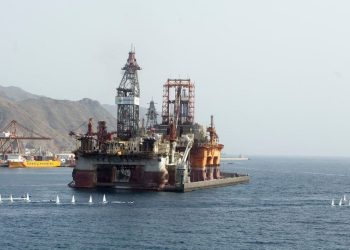
On Monday afternoon, a shipping magnate of Las Palmas Port contacted Canarymaritime to report that the board agenda of Las Palmas Port had included, for 23 July, a commercial transaction between Transcoma and Laskadiris Group at the Reina Sofía Dry Dock. It was an open secret, as Canarymaritime reported, that the deal would go ahead—especially given the debt of a Transcoma subsidiary that this summer has ended up in bankruptcy proceedings. The process has been accelerated. The next step would be the sale to Hamilton, where there is already a Canary-based shipping agent that has hired an auditor to carry out a due diligence and make an offer for the island business. On 14 July, Transcoma reappointed Ildefonso Cordero as sole administrator of the company formed in Tenerife in 1837.
From board approval to the final move in a corporate chess game
The board of directors of Puertos de Las Palmas, where much of the political class appears to listen from the side while signing documents electronically and checking WhatsApp, will unanimously approve transferring a listed plot of public domain in Functional Area 6. This is not a mere administrative step between two companies: it represents the final move in a corporate chess game that began in 2019 and definitively consolidates the Greek capital group’s control over the back office of naval repair in the mid-Atlantic.
Accordingly, permission will be granted for the transfer of 8,076 square metres of port land owned by Hamilton y Compañía, S.A. to Astilleros Canarios, S.A. (Astican), which is owned by the Greek group Laskadiris. The concession, originally awarded in February 2019 for “naval repairs and a multi-purpose terminal”, is located even further along the coveted berthing line of the Reina Sofía Dry Dock. In an irony that has not gone unnoticed among La Luz ship agents— the port’s main repair hub for platforms and vessels, under the operational control of the Hellenic group Laskaridis—it can now also technically hold the property rights to the name “Reina Sofía Dry Dock” from Greece.
A “white label” and a strategic perimeter
To understand the depth of the transfer, you have to look back seven years. In 2019, Hamilton’s landing (integrated into the Transcoma group) on that strip of land did not respond only to a natural expansion of its business volume. What was a shipping agent doing in that operation? Getting in the way. Behind the scenes in the dockyard, the main operators interpreted the move as a spatial blockade maneuver: the use of a white-label brand aligned with the surrounding Laskaridis environment to physically interpose itself on a strategic plot and choke off the growth of emerging competitors in the ship repair business.
That initial award triggered a violent clash of interests. Complaints were lodged that headed into the labyrinth of contentious-administrative jurisdiction, where they got stuck for years in the judicial limbo that usually plays to the advantage of those who hold physical control of the land. They are still there.
From paralysis to monetising the concession
Time has ended up giving reason to the logic of Canary-based corporate power—or, as the saying goes, Basque capital. While the court case drags on in the courts, Hamilton’s effective use of the surface has served to cool the market and keep the expansionist hopes of Basque- or Canary-capital competitors frozen. Once the time-driven attrition is fulfilled and the threat of a real alternative along the dock line has been neutralised, the scenario has been cleared for execution of the original plan.
Seven years later, Hamilton (Transcoma) “places” the asset with its natural recipient: Group Laskaridis. Through the resolution authorising the transfer of concession 15-C-1003, the Greek group’s industrial footprint at the Reina Sofía Dry Dock “from Greece” expands without opposition, absorbing not only the naval repair workshops, but also the multi-purpose operational activity that has been authorised.
A de facto monopoly in the Atlantic enclave
What in 2019 was presented to public opinion as a healthy diversification of private operators through Hamilton’s entry has, in 2026, culminated in an absolute concentration under the Laskaridis seal. The move allows the Greek tycoon to consolidate a position of de facto monopoly over the critical infrastructure for heavy repair in Gran Canaria. By integrating Hamilton’s 8,076 square metres into the operational structure of the Greek multinational, the group not only optimises its shipyard synergies, but also definitively invalidates the legal disputes accumulated along the way. With the formal title transferred and validated by the Port Authority, the competitors’ lawsuits risk turning into a melancholic debate about facts already made. Thus, the ship repair business in the Atlantic enters a new phase. The pieces have returned to the original board.
The article “Crónica del secuestro de Laskaridis del Dique Reina Sofía tras siete años de ‘teatro’ de Transcoma en el puerto de Las Palmas” was first published at canarymaritime.com.