




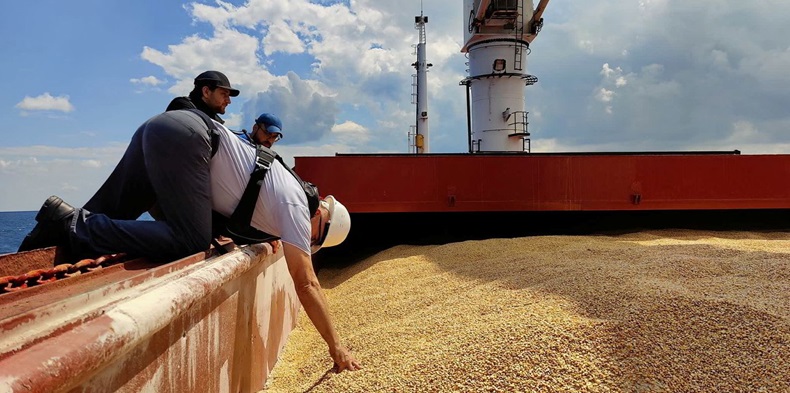
At the Gran Canaria dock, the movement of durum wheat takes on singular importance for the local processing industry. EU imports in this category reached 1,845,373 tons, showing stability with a slight decrease of 4%. Canada, the world’s main supplier of durum wheat to Europe, accounts for 55% of the shipments with 1,015,110 tons, followed at a great distance by Kazakhstan with 21.3%. In contrast, durum wheat semolina (expressed in grain equivalent using the factor of 1.5) shows a modest flow of just 6,544 tons, led by Morocco with a share of 59.3%.
Community exports demonstrate renewed dynamism, totaling 36,864,188 tons across all monitored products, representing a year-on-year growth of 16%. Soft wheat leads external sales with 22,054,486 tons, with principal destinations being Morocco (14.7%), Saudi Arabia (8.3%), and Egypt (8%). Barley also experienced an extraordinary rebound of 86%, reaching 8,574,207 tons exported, driven by strong demand from China, which accounted for 19.3% of the total, and from Saudi Arabia with 18.9%.
The final report from the Directorate General for Agriculture (DG Agri-E.4) of the European Commission for the closure of the 2025/2026 marketing year will be published on July 8, 2026. Just a week later, on July 15, the first report of the 2026/2027 campaign will be disseminated. Stevedoring companies and bulk terminals in the Canary Islands closely monitor these weekly updates to assess storage availability in silos and anticipate the logistics costs of a peripheral region exposed to fluctuations in global agricultural markets.
The meticulous control of international agri-food traffic has become a strategic pillar for the archipelago. Through the TAXUD surveillance system, the European Commission centralizes daily real import and export data transmitted by national customs authorities, using information from the Single Administrative Document (SAD) as a basis. This mechanism excludes intra-community trade, focusing exclusively on flows with third countries. Customs send these declarations at least once a week in accordance with the Implementing Regulation (EU) 2015/2447. Although Brussels aims for statistical excellence, it warns that the data is dynamic and subject to corrections or specific delays by member states.
Canary Islands’ position stands out within Spain’s importing strategy for grains and derived products during the 2025/2026 commercial campaign. By the end of week 49, the consolidated volume of purchases of the community block reflects global trends that directly impact the island’s supply. The total EU imports reached 23,853,164 tons, representing a year-on-year contraction of 19% compared to the previous year, when over 29.4 million tons were recorded. This reduction is due to a readjustment of supply chains following a period of intensive stocking and the increasing cost of certain Atlantic freights.
Spain leads the volume of corn imports within the European space, consolidating 6,856,054 tons out of a total continental volume of 16.8 million tons. This massive influx of foreign grain sustains the feed industry and livestock, a critical factor for the primary sector of the Islands, which relies on external supplies of basic inputs for animal feed. The community corn market’s main supplier is Ukraine with 7.7 million tons (45.8% market share), followed by the United States with 5.2 million tons (30.9%) and Brazil with 3 million tons (17.8%). Las Palmas operates as a receiving and redistributing logistics node on these transatlantic routes, taking advantage of the import license exemptions in effect since November 2016 for most of the cereal sector.
The analysis of wheats reveals reverse trade dynamics within the community territory. Soft wheat imports in the European Union totaled 3,752,443 tons in the first 49 weeks of the campaign, experiencing a notable decline of 48% compared to the previous year. Canada stands as the main partner in this segment, supplying 1.3 million tons (35.1% market share), followed by Ukraine with 26.1%. Meanwhile, soft wheat flour, expressed in grain equivalent using a conversion factor of 1.37, recorded an entry into the Union of 226,606 tons, with the United Kingdom being the predominant origin at 55.2% of the market.







