




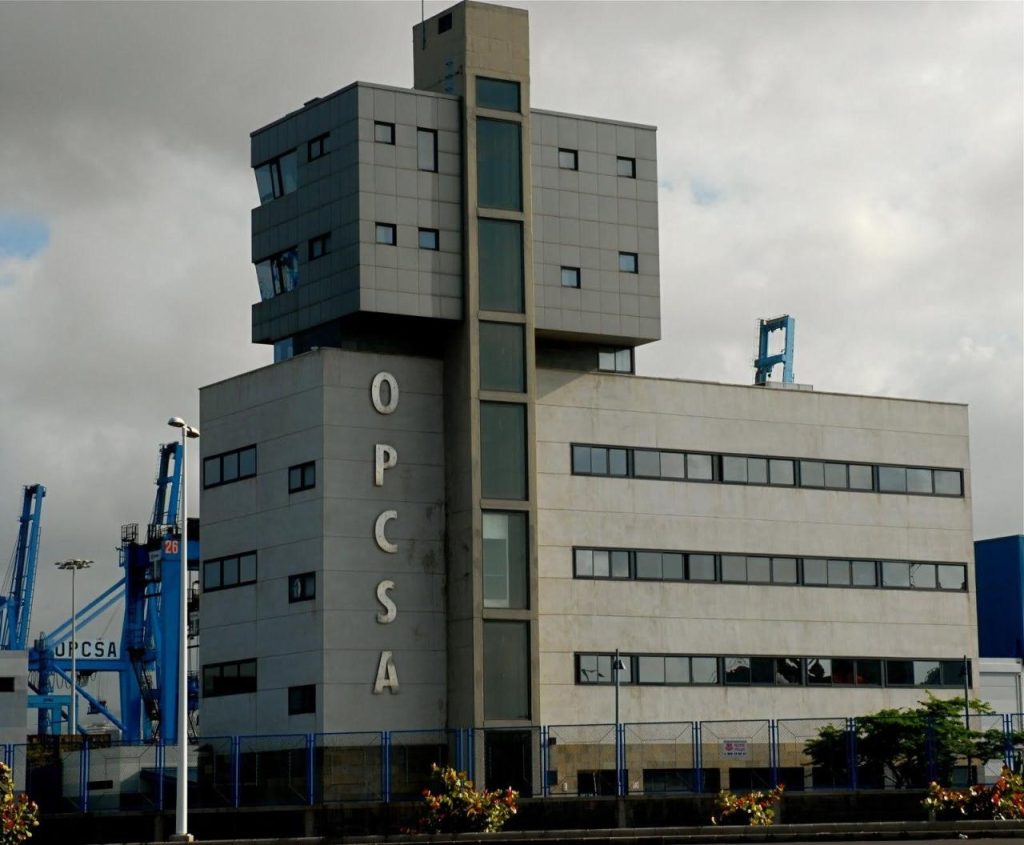
In December 2006, the Port of Las Palmas celebrated with contained euphoria a milestone that seemed to mark the beginning of a golden era: the docking of the Maersk Seville. With its 9,000 TEUs capacity, the ship was the symbol of an ambition that then-Port Authority director José Miguel Pintado and OPCSA manager Juan Pérez defined as the definitive consolidation of the Canary Islands as the ‘hub of West Africa.’ Twenty years later, the Canary port continues to orbit that same glass ceiling of 1.5 million, due in large part to the Houthi leaders in the Red Sea in 2024, while the Aponte family’s project in Togo has transformed from a sketch into the gravitational center of transshipment on the West African coast.
The doctrine of Juan Pérez
During that period, while Lomé began to operate and no one in Las Palmas bet on that African competition, the Port Authority of Las Palmas officially discontinued the existing provision for the outstanding debt of OPCSA for a series of settlements related to the charges for loaded or unloaded, empty or full containers, from the dock to the ship or vice versa between 1995 and 1998, for an amount of 519,000 euros: ‘The right to collect and demand payment of said debt has expired,’ the resolution stated.
The figures from that period —1.4 million TEUs and a growth of 17%— outlined a horizon of unlimited expansion. However, two decades later, the chronicle of that success is read in 2026 with the sober tone of a strategic stagnation. While Las Palmas struggles to break through the glass ceiling of those same 1.5 million containers it was already nearing in 2006, across the mirror, in the Gulf of Guinea, the Lomé Container Terminal (LCT) has transitioned from being a project on paper to becoming the logistical executioner of the archipelago.
The fiscal year 2025 has revealed a concerning drift in the transparency of Las Palmas. As the year closed, there was a volume of 1,546,389 TEUs, but there is a wall: An information blackout regarding transshipment. There are no broken down data certifying how many of those containers are in transit to other markets and how many correspond solely to local consumption. This blank data suggests that Las Palmas’s role as a redistribution hub is being cannibalized by centers like Lomé, which already moves more than 2 million TEUs annually with a transparent service record focused on international transit. The captive market does not know, does not respond. A terminal in Lomé moves what three in the whole province of Las Palmas do.
The deep-water takeover
The comparison is painful for the results balance of the Las Palmas Ports brand. In 2006, the competitive advantage of the Canary Islands was its binomial ‘African geography with European security.’ It was hoped that large ships coming from the East would leave their cargo here to be redistributed to the west coast of the continent. But the market does not wait for bureaucracy or space limitations.
TIL (Terminal Investment Limited), the executive arm of MSC, understood that the real business was not in ‘waiting’ for Africa from the Canary Islands, but in ‘being’ in Africa. The 35-year concession in the Port of Lomé, which celebrates its 20th anniversary in 2026, transformed a coastal enclave into a deep-water terminal with 16.6 meters of depth and a maneuvering capacity that already allows the operation of vessels of 16,000 TEUs, rendering small those giants that amazed La Luz in 2006.
From trial to hegemony
At that press conference in 2006, OPCSA director Juan Pérez admitted that the docking of the Maersk Seville was a ‘test’ to see if the 2,000 containers destined for Africa remained in the islands rather than going to the Mediterranean. Twenty years later, the response from the market has been clear: those containers no longer need to stop in Las Palmas unless they are empty. They head directly to Lomé, which serves as the true lifeline for Mali, Niger, and Burkina Faso.
Lomé has not only gained in infrastructure; it has gained in human capital management with 1,000 workers who do not earn 8,800 euros a month. While the Canary Islands faced the rigidities of the Spanish stevedoring model, LCT developed on-site training centers, optimizing operations under TIL’s global standards.
The Canary dilemma
The Port of Las Palmas remains an unparalleled service center —ship repairs, bunkering, and supply—, but in the pure war of container transshipment, the parallelism with Lomé serves as a textbook warning for any logical analyst: The geographical advantage is perishable if not accompanied by aggressive investment in draft and a operational flexibility that competes with the new southern titans. Las Palmas closed 2006 ‘betting on the future.’ The problem is that the future decided to build itself in Togo.
The stagnation of Las Palmas over the last two decades coincides with TIL’s aggressive deployment in the Gulf of Guinea. While in the Canary Islands the port debate was consumed in bureaucracy, stevedoring costs, and draft limitations, the MSC group —the parent company of TIL— designed in Lomé an infrastructure capable of ignoring the technical stops in the islands. With a draft that already reaches 16.6 meters, Lomé now operates mega-ships that Las Palmas can only do so occasionally. The Canary port, which in 2006 boasted technology and European security, has discovered that the logistical efficiency of a modern, private African enclave is an unbeatable competitor in the cost war.
News written by Pedro Marrero. Edited and verified by José L. Jiménez. Cross-verified information without institutional filters. This analysis has not been funded by official advertising nor conditioned by lobbying interests.







