




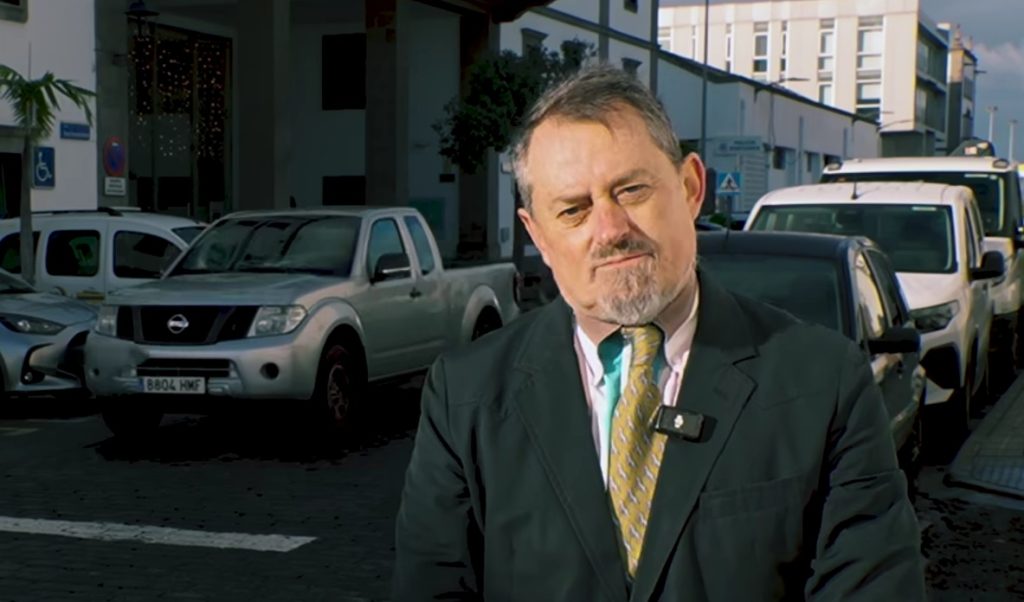
In the port historiography of the Canary Islands, few names evoke as much intensity as that of José Manuel Arnáiz (2003-2005). In a new excerpt from the audiovisual series ‘Presidents on the Dock’ by the business association Oneport, which has started to circulate on social media, the civil engineer who led the Port of Las Palmas at the turn of the millennium has stepped forward to safeguard his management under a premise that blends technical nostalgia with iron discipline: ‘History is written, stored, and preserved’.
For Arnáiz, the success of what we now know as the great tricontinental hub was not a fluke of fate, but the result of a machinery that knew no rest. His defense rests on a work ethic that is almost Spartan: operational services 24 hours a day, from Sunday to Monday. The former leader justifies this frenetic pace with a market logic that today sounds like geopolitical pragmatism: ‘Sundays are working days in Africa.’ Under that vision, Las Palmas could not afford the luxury of Western pause if it wanted to be the interlocutor of a continent that does not stop its machines.
The engineer versus the bureaucrat
In a video interview, it is not the politician who speaks, but the technician who spent 15 years on the dock before occupying the presidential chair. That experience as an in-house engineer allowed him, in his own words, to know the internal gears of an environment that demands surgical precision. His account sketches a phase of exponential growth where the port not only added tons and TEUs but also gained international relevance, ceasing to be merely a service stop to become a leading player on the transatlantic board.
The audiovisual production of this excerpt, under the OnePort series brand, seeks not only historical archiving but also positions the debate at a key moment in contemporary port affairs. By recalling that his tenure was a ‘thrilling phase’, Arnáiz sends an implicit message to contemporary management: global relevance is earned with seamless operability and a deep understanding of the terrain. While the Port of Las Palmas faces new challenges of competition and governance today, Arnáiz’s figure emerges to remind us that the foundations of current competitiveness were laid with Sunday shifts and an obsession for efficiency that, decades later, he himself ensures that history does not forget.







