




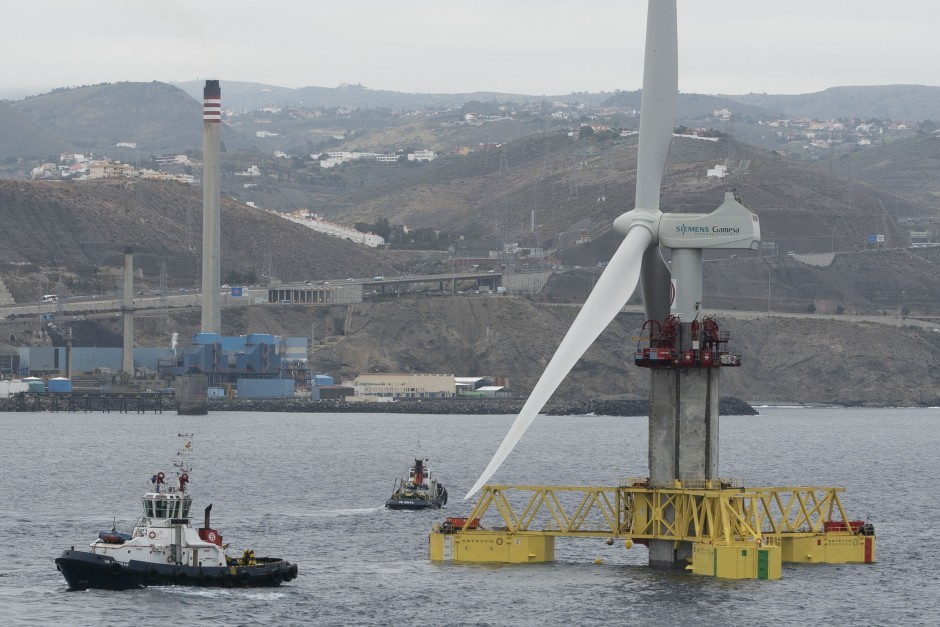
Until recently, closely associated with the offshore wind sector, now silence. In the business world, sometimes silence is an investment strategy; in Canary Island politics, it is often a sign of caution in the face of power. The president of the Cabildo of Gran Canaria, Antonio Morales, has once again raised the flag of territorial balance by denouncing that Proexca —the executing arm of internationalization and foreign capital attraction— has become a sort of exclusive fiefdom of Tenerife. However, at the headquarters of the Chamber of Commerce of Las Palmas and the Canary Confederation of Entrepreneurs (CCE), the phones seem to be on airplane mode.
Morales has not minced words. With the data on the table, he has pointed to a ‘poker’ of positions: president, vice president, CEO, and general director, all originating from the island across the way. Additionally, the creation of the Office of Strategic Projects has brought seven new jobs with postal codes from Santa Cruz de Tenerife. For the Cabildo, this is not just a matter of institutional aesthetics but also of economic efficiency: a foreign investor landing in Gran Canaria should not have to cross the body of water to find face-to-face interlocution with the public agency that should oversee their implementation.
The striking aspect of this offensive is the institutional loneliness of Morales in front of the entities that, in theory, should be the first interested in the decentralization of resources. The Chamber of Commerce of Gran Canaria, which according to the Cabildo even voted against this centralized selection process within the Proexca council, has avoided bringing that discrepancy into the public sphere. The silence of the Chamber and the CCE suggests a risk calculation: denouncing the ‘imbalance’ of Clavijo directly implicates the command structure of the Government Presidency.
In economic circles, this silence is interpreted as ‘organic peace’. The employers’ associations depend on the fluidity of their relationships with the regional Executive for managing funds, subsidies, and promotion programs. Breaking ranks with Morales, even though his arguments regarding the inefficiency of a centralized office on a single island are difficult to challenge from a market logic perspective, would mean opening a battleground that many local entrepreneurs prefer to avoid as long as the economic cycle maintains some inertia.
Morales insists that this centralization projects a negative image outward. ‘It conveys that support for investment is monopolized in Tenerife,’ he warned. While the Cabildo raises a motion this Friday at the plenary session to demand the relocation of positions and a real ‘archipelagic’ approach, the employers’ association observes from the sidelines. The silence of the Chamber and the CCE is, in itself, a message. It is the acknowledgment that, in Canaries in 2026, the struggle for territorial balance remains a battle that politicians fight at the wharf, while capital prefers to wait at the terminal, avoiding noises that might scare away foreign investment that, ironically, is what Proexca should be distributing equitably.







