




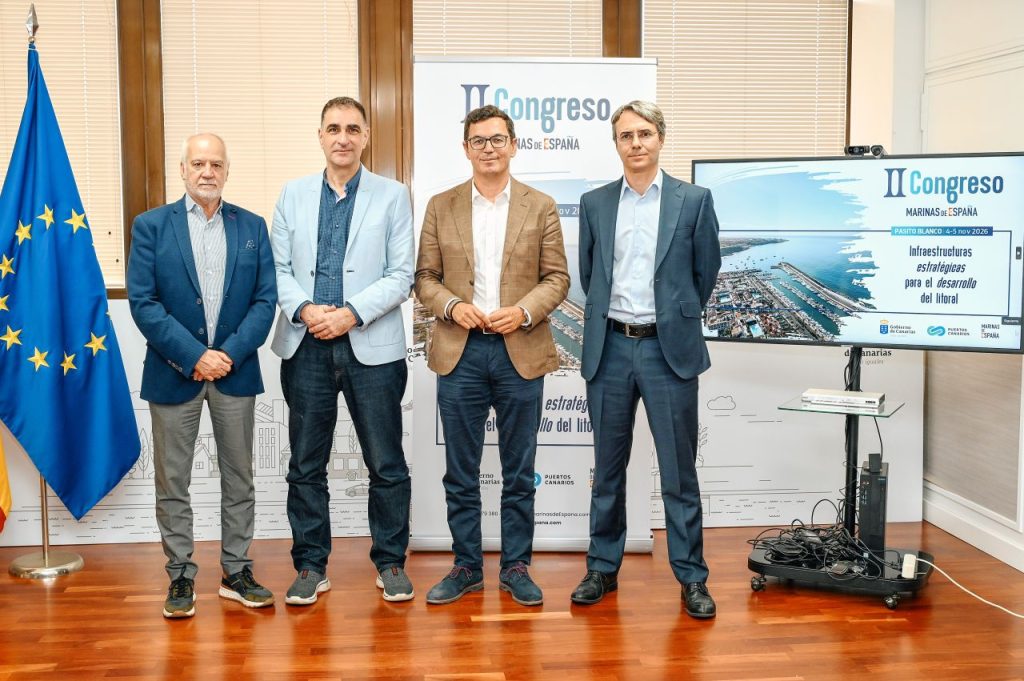
The sports marina sector in Spain has decided to take action at a critical moment for the management of coastal infrastructures. The choice of Gran Canaria as the venue for the II National Congress of Marinas in Spain, to be held on November 4 and 5 at the ExpoMeloneras center, places the archipelago at the epicenter of a debate that transcends mere recreation. With the participation of 300 professionals and representatives from a hundred sports ports, the industry seeks to redefine its role as a strategic asset in the blue economy, moving away from the traditional image of a leisure enclave to position itself as a driver of industrial and tourism development.
The presence of Pablo Rodríguez Valido, Counselor of Public Works of the Government of the Canary Islands, and Tomás Azcárate Díaz de Losada, President of Marinas of Spain, at the event’s presentation underscores the urgency of coordinating port governance with current sustainability demands. Under the title Strategic Infrastructures for Coastal Development, the congress aims to address the legal insecurity that often surrounds administrative concessions on the Spanish coast. For managers and concessionaires, stability in regulatory frameworks is the fundamental variable that will determine the flow of investments necessary to modernize facilities that compete in an increasingly aggressive global market.
The Pasito Blanco Sports Port, represented by Santiago de Armas, will act as the host port in an environment that Canarian Ports describes as a laboratory for innovation in nautical services. The integration of sports ports into the urban fabric and their ability to generate skilled employment are central axes of an agenda that also focuses on the digitalization of port management. In a context where environmental pressure on the coast is at its maximum, technical experts will seek solutions that reconcile economic exploitation with the protection of ecosystems, a requirement that financial markets already impose on any large-scale infrastructure project.
This national meeting arrives at a time of reconfiguration for the sector in the Canaries, where the Association of Sports Ports seeks to strengthen its influence in public decision-making. Public-private collaboration emerges as the only vehicle capable of covering the costs of the energy transition and adaptation to climate change in sports docks. By bringing together public administrations and experts in the blue economy, the Gran Canaria congress aspires to draft a clear roadmap that allows Spanish marinas not only to maintain their leadership in the Mediterranean and the Atlantic but also to transform into high-value-added logistical nodes for the communities in which they operate.







