




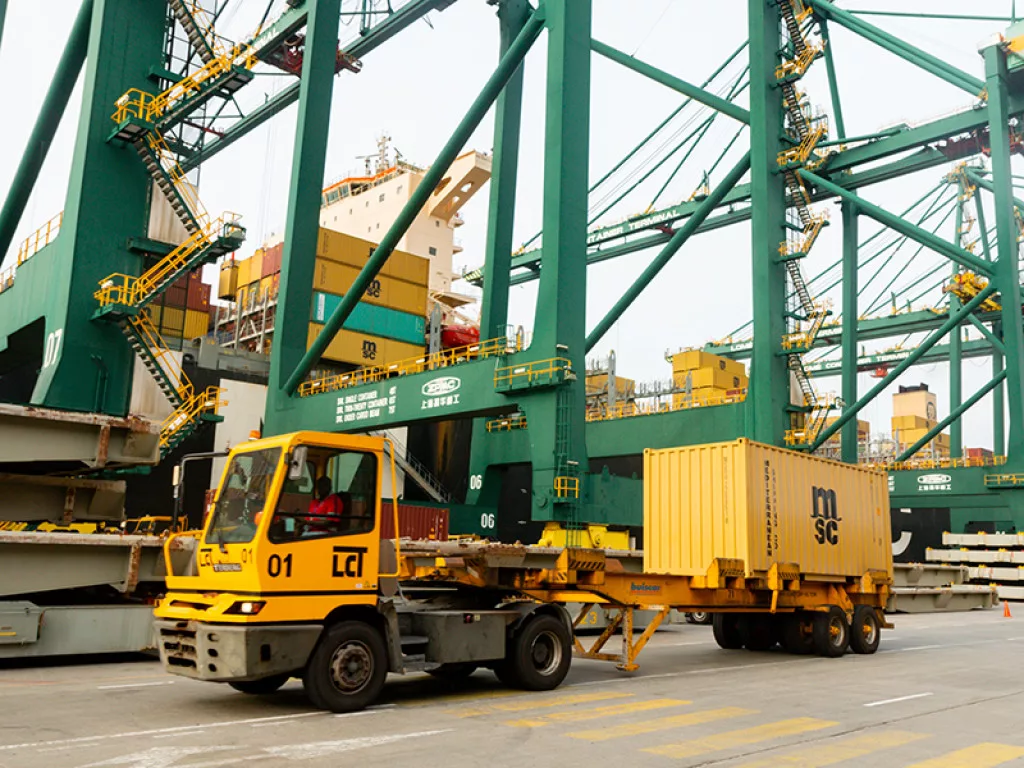
The control of the maritime façades of West Africa has entered a phase of intense strategic reconfiguration. Six decades after funding and designing the foundations of Togo’s logistics infrastructure, the Government of Germany has launched a diplomatic offensive to regain its historical influence in the Autonomous Port of Lomé, a major competitor of the Port of Las Palmas, with both dominated by MSC.
The official visit to the facilities by the German Federal Foreign Office Minister of State, Serap Güler, consolidates a shift in Berlin’s foreign policy, which seeks to position its engineering corporations in light of the impending megaprojects focused on digital modernization and ecological transition at what is regarded as the largest container hub in the region.
The background of this approach responds to an explicit request from Togolese authorities, formalized by the Maritime Economy Minister, Edem Kokou Tengue. Togo aims to capitalize on European technological experience to transform the port into a connected and smart world-class facility, capable of withstanding the growing competitive pressure from neighboring terminals such as Abidjan (Ivory Coast) and Lekki (Nigeria).
Berlín’s interest transcends mere bilateral cooperation: Lomé operates as the only natural deep-water port on the West African coast, allowing it to accommodate state-of-the-art vessels and control a commercial influence area that supplies over 80 million consumers in the Sahel’s inland markets, directly impacting the economies of Burkina Faso, Mali, and Niger.
The German involvement in this port asset is not a recent phenomenon, but rather a historical continuity exercise dating back to the mid-20th century. Inaugurated on April 26, 1968, the original port was designed by German engineers and funded by over 70% from the public development bank Kreditanstalt für Wiederaufbau (KfW), executed by a construction consortium led by Hochtief AG, now owned by the Spanish construction firm ACS Dragados. For the Togolese executive, appealing to this foundational origin serves to balance the geopolitical scale against the advance of Chinese state investments and the large European terminal operators controlling the continent’s current concessions.
The lines of collaboration proposed by Lomé also introduce military security and environmental governance variables into the South Atlantic arena. The Ministry of Maritime Economy of Togo has formally requested the technical and operational support of Germany to combat piracy and illegal trafficking networks operating in the Gulf of Guinea, one of the highest-risk areas for global maritime transport. This cooperation framework will align with the dictates of the Lomé Charter on maritime security and protection adopted in 2016, linking defense assistance with the promotion of the so-called sustainable blue economy.
The return of Germany to the strategic landscape of Lomé introduces a significant competitor in the race for the management of specialized terminals for hydrocarbons, minerals, and fishing. As global supply chains demand shorter and more resilient routes to Europe, the PAL positions itself as the priority transshipment center of the Sahel. For Berlin, control or preferential participation in the modernization of these docks not only represents a business opportunity for its capital goods industry but also a necessary mechanism to secure supplies of critical raw materials and contain logistical instability at the southern border of European trade.







