




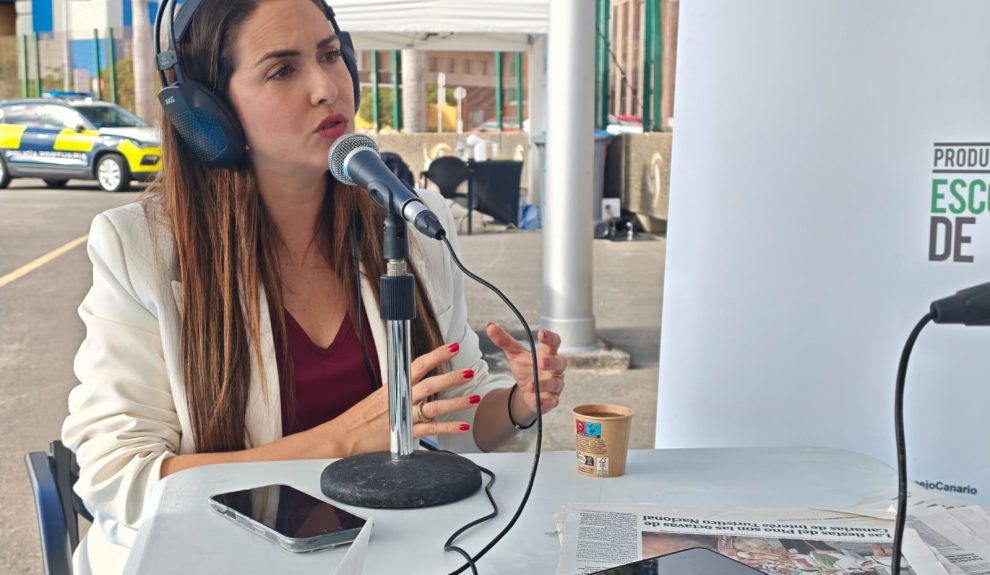
The management of the Foundation Ports of Las Palmas has addressed the growing controversy surrounding its legal viability and the control of its corporate structure. Betsabé Morales, the executive director of the entity since March 2025, broke the institutional silence this Friday on ‘El Espejo Canario’, to assert that the organization operates under strict transparency criteria and with a strictly private financing model. Her statements coincide with a critical moment of budget scrutiny by Puertos del Estado, agencies that are closely monitoring the fate of the foundation’s assets and the influence of major labor unions in the docks of La Luz. This Monday there is an assembly of patrons to analyze the accounts.
‘We are working’
She stated that they have tried to intimidate and scare her ‘and I do not understand this urgent alarm that has emerged,’ she affirmed. ‘The previous director left just before me, what I want to say is that the Foundation was somewhat paralyzed,’ said Morales. ‘I do not understand this attack,’ she stated. ‘We are working and thanks to Puertos del Estado, who has helped us a lot,’ affirmed the manager of the Foundation Ports of Las Palmas. Before the month of July, the Foundation Ports of Las Palmas and Puertos del Estado will meet to seek a way out of the reputational crisis and to plan objectives ‘in projects that work for the port community.’
Relations with Puertos del Estado
She said that the current management is different from what was inherited in a complex scenario marked by operational paralysis, document blocking at the Ministry of Finance, and a profound crisis of confidence with the commercial operators of the Port of Las Palmas. Morales described the situation upon her arrival as that of an entity with great potential but completely ‘stopped’ and lacking a sufficient administrative structure. The strategy deployed during the past year, she said, has focused on regularizing accounting obligations and reestablishing channels of communication with the Port Authority of Las Palmas and the private logistics corporations that make up the board.
Accounts
The financial aspect is at the core of the technical debate with the auditors of the state public sector. In contrast to reports highlighting chronic financial turmoil, with accumulated net losses of 128,115.91 euros in the 2025 fiscal year and red numbers of 138,660.30 euros in 2024, management maintains that the support of the activity does not burden the state coffers. The institution’s revenue sources depend entirely on annual donations from private patrons and the real estate profitability derived from leasing its headquarters, an asset that provides a flow of 319,650.45 euros a year to the firm’s balances.
Founding Patrons
The private capital that oversees the organization is led by the main multinational companies at the dock. Astilleros Canarios (Astican) —under the control of the shipping holding of the Greek Laskaridis family—, Boluda Corporación Marítima, and Trancoma (Hamilton & Cía) bear the highest ordinary patronage contributions, each estimated at 30,000 euros annually. This cash injection contrasts with the position of the Port Authority and the founding patrons —which genuinely include the City Council of Las Palmas de Gran Canaria, the University, and the Naval Command of the Canary Islands— whose contributions remain at zero, leaving the entity’s viability in the hands of the commercial interests of the stevedoring and shipping firms.
Powers
The scrutiny of these resources has become the main argument of defense for management against accusations of opacity and corporate capture by sectoral labor unions such as Fedeport or Oneport. The management team has subjected the annual accounts to a voluntary external audit to substantiate the allocation of funds before the assembly of patrons. Management acknowledges the existence of a strong political component and pressures in the public port sphere, although it categorically denies any attempt of interference or imposition of specific profiles in the hiring processes of the staff.
The strategic horizon designed to evade the ministry’s liquidation order is now articulated around attracting young talent, digital innovation, and international cooperation. The Foundation promotes programs aimed at bridging the gap between the technical qualification demands of shipping companies and local curricula through employment intermediation platforms coordinated with the Ministry of Education. However, the future of these initiatives remains tied to the technical assessment of the Interreg MAC European projects, where the Foundation acts as the leader and assumes a structural financial risk that will postpone any decision on definitive closure until 2028.







