




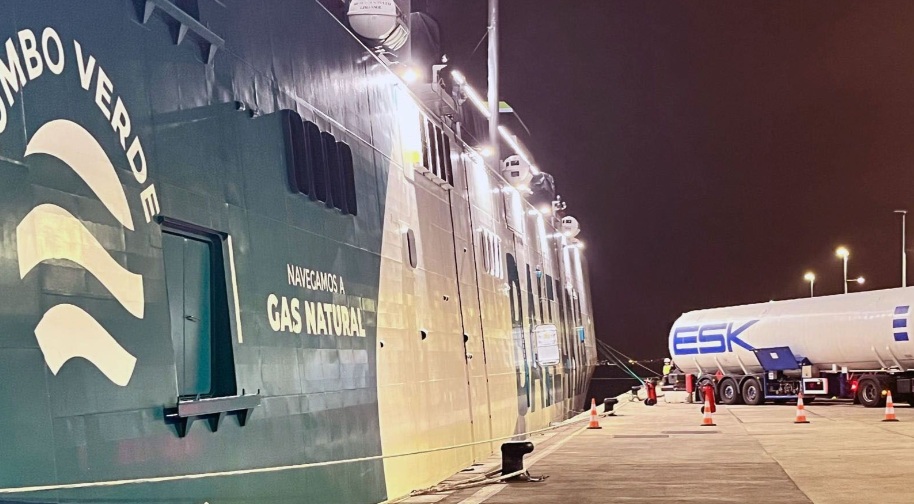
The Port of Las Palmas has executed a maneuver that structurally alters the balance of logistical power in the Central Atlantic. Overnight this Monday, the Juan Sebastián Elcano dock was the scene of the first liquefied natural gas (LNG) supply in the history of this port facility, aimed at fueling the tanks of the innovative fast ferry Mercedes Pinto, the latest addition by Baleària Canarias to strengthen the strategic corridor between Tenerife, Gran Canaria, and Fuerteventura. No commercial advertising negotiations have been established for the preparation of this news. The energy supply has been carried out by the Valencian company ESK of the Corell family.
The general director of Baleària, Georges Bassoul, stated that this move positions the Canary subsidiary at the forefront of responsible maritime mobility, establishing a technical standard that will force other operators in the region to accelerate their fleet renewal plans. LNG serves here as a necessary financial bridge: it enables compliance with the immediate goals of reducing nitrogen oxides (NOx) and preparing the machinery for the arrival of even cleaner energy vectors. In a fragmented and politically sensitive market like the Canary Islands, control over fuel efficiency and the ability to operate with net-zero emission technologies in port are consolidated as the true variables that will determine which companies will survive the industrial reconversion of maritime transport.
The operation does not represent a mere routine technical supply; it constitutes the formal deployment of a new competitive advantage to maintain the port’s hegemony against the growing pressure from logistics hubs in North Africa. The maneuver was resolved using a logistical engineering formula known as the MTTS (Multi Truck To Ship) system, a simultaneous transfer operation that requires millimeter precision to avoid pressure drops in the cryogenic fuel flow. Two tanker trucks operated in parallel to pump an equivalent of 600 MWh of energy directly into the ship’s hold. The transfer speed reached a combined flow rate of 1,200 liters per minute —600 liters per unit— drastically reducing the ship’s downtime at the dock, a critical factor in a sector where profitability is measured by the constant turnover of floating assets. For Baleària, this marks the inauguration of the land supply model with tankers in the archipelago, breaking away from the traditional reliance on heavy fossil fuels.
Sustainable bunkering as a strategic asset
The financial dimension of the operation transcends the corporate sphere of the shipping company. The bunkering market is one of the most stable economic drivers in Gran Canaria. The Port of Las Palmas holds the undisputed leadership of this activity in the Central Atlantic and ranks second in the Spanish port system, a condition that local authorities consider vital to preserve.
Diversifying the fuel portfolio is the only way to mitigate the risk of obsolescence in light of changes in international maritime regulation. Vessels crossing major trade routes increasingly demand ports capable of providing transition energy to avoid tax penalties in EU waters. From the perspective of public management, enabling the regular supply of LNG in Las Palmas acts as a protective shield to ensure that major international shipping companies continue to choose the eastern islands as a technical call node rather than diverting to competing ports outside the European customs area.
Return on investment and dual engine technology
The incorporation of the Mercedes Pinto into the interisland fleet represents a high-capital intensity investment. With an investment amounting to 128 million euros, this fast ferry is positioned as a high-speed infrastructure designed with operational efficiency and reduction of carbon footprint criteria. Its propulsion plants are equipped with next-generation dual engines, capable of alternating the use of liquefied natural gas with biogas or synthetic fuels that are neutral in CO₂ emissions, completely eliminating particle and sulfur oxide emissions during voyages.







