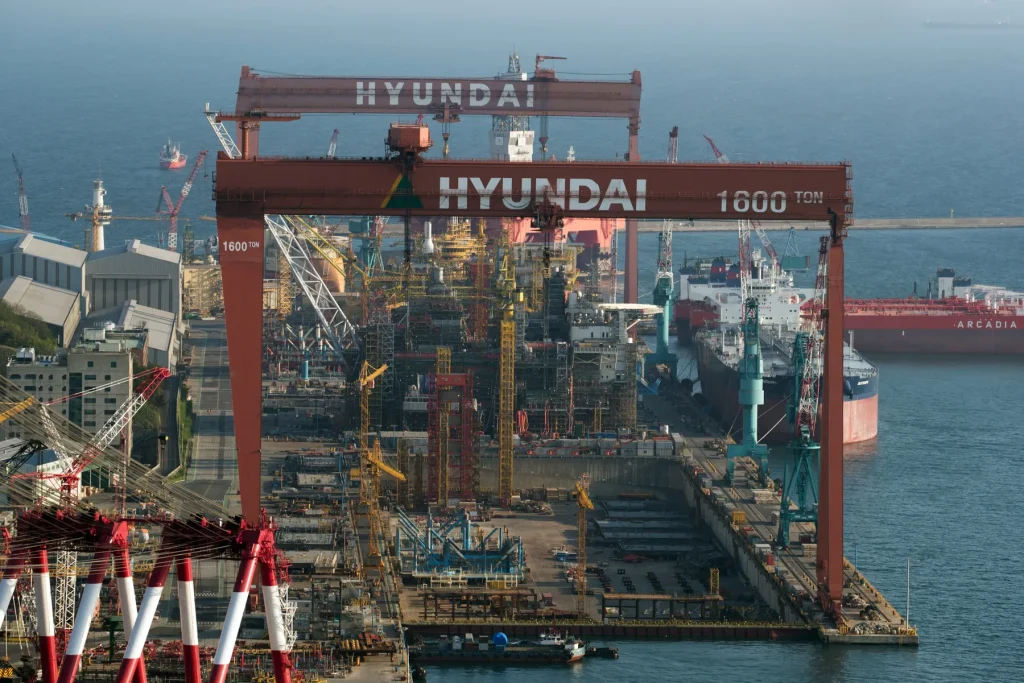
The South Korean shipbuilding giant HD Hyundai Heavy Industries has intensified contacts with the Moroccan government to take over the operation and management of the new industrial complex at the Port of Casablanca. The operation, channeled through the corporate division HD Korea Shipbuilding & Offshore Engineering, aims to consolidate a logistics and technical platform in Africa dedicated to maintenance, major repairs, and overhaul (MRO) of merchant fleets and warships. This maneuver responds to a redesign of Seoul’s global manufacturing footprint, aimed at decentralizing assets outside the Korean Peninsula to counteract the loss of competitiveness in costs.
The positioning in the United States maintains a differentiated profile, conditioned by the strict demands of the Jones Act and urgent needs for renewal of the U.S. Navy fleet. In that market, alliances are oriented towards providing advanced engineering support and modernization of existing shipyard infrastructures to meet Pentagon defense contracts, where the role of the Canary Islands is very limited due to bureaucracy.
The integration of Casablanca into this international network places Morocco’s economic capital in a privileged position within the map of industrial geopolitics. The alliance with HD Hyundai endows the country with heavy manufacturing capabilities that alter the industrial balance of North Africa, offering major Western maritime powers a reliable partner for the upkeep of their fleets in a context of increasing tensions over control of global supply chains.
Morocco has become part of a high-priority expansion map for the multinational that includes economies such as India, the United States, Indonesia, Peru, and Saudi Arabia. The choice of the Maghreb enclave responds to criteria of geographical connectivity and institutional stability on the Atlantic front, a critical transit area that registers increasing traffic density from routes in the South Atlantic, the Mediterranean, and the hydrocarbon transport corridors surrounding the Strait of Gibraltar. The defensive and industrial scheme proposed by the Korean engineers aims to unify under a single operational command the civil engineering of container ships and the logistics of defense for frigates and patrol vessels.
The acceleration of civil works at the Casablanca shipyard coincides with a change in global order books. The Moroccan port facilities will have dry docks and heavy lifting systems capable of absorbing structural repairs that until now were almost exclusively referred to Canary Islands shipyards. Control of this infrastructure will grant HD Hyundai a competitive advantage in securing emergency service contracts in one of the most congested nautical transit zones in the world.
The loss of market share to Beijing
The offensive by HD Hyundai in North Africa is a direct response to the absolute dominance that Chinese state shipyards have imposed in the medium-capacity commercial vessel segment. Data from industry consulting firms show a structural shift in the balance of power among global shipyards over the last two decades. In 2007, South Korean firms controlled 31% of global construction orders, surpassing China’s 27%. Current macroeconomic projections depict an adverse scenario for Seoul: the Chinese industry captures nearly 62% of the global market, reducing South Korea’s share to a meager 20%.
The determining factor in this loss of ground lies in the structure of labor and steel sourcing costs. The production of bulk carriers, conventional tankers, and standard container ships in Chinese factories benefits from significantly lower operating costs. Sources from Korean investment committees point out that naval developments in emerging competitors like Vietnam or the Philippines show labor costs up to eight times lower than those of Ulsan or Geoje shipyards, which allows for a 15% reduction in the final manufacturing price of a merchant vessel.
Production plants that incorporate advanced industrial automation systems, robotic assembly lines, and workflow optimization aim for additional cost reductions exceeding 20%. In this context of pressure on profit margins, the corporate strategy of Seoul prioritizes geographical locations outside its national territory that combine competitive industrial wages, predictable regulatory frameworks, and immediate access to major supply lines connecting European and American markets.
Casablanca emerges as the central node
HD Hyundai’s ambition in Casablanca exceeds the limits of a traditional repair concession. The strategic plans submitted to international investors project the creation of an industrial outsourcing ecosystem involving local manufacturers of heavy metal structures, suppliers of mechanical components, specialists in hydraulics, and precision foundries. The South Korean corporation links the success of the plant to the establishment of an integrated value chain that emulates the successful model developed by the automotive sector in the Tangier-Kenitra axis.
The Moroccan naval base will diversify its technical capacities through the introduction of specialized service lines in high-complexity technologies. Notable programs include maintenance programs for membrane tanks for liquefied natural gas (LNG) carriers, calibration of state-of-the-art port cranes, and integration of eco-efficient propulsion systems. The development of these auxiliary divisions requires continuous technological transfer and technical training for local engineers, a process in which Moroccan universities and technological centers will assume an operational support role.
The maritime facade of Casablanca will operate as a gravitational center for deep-sea fishing fleets, general cargo vessels, and military navies in the region seeking to shorten downtime due to breakdowns. By avoiding prolonged transits to Asian shipyards or the high costs of bases in the northern Mediterranean, shipping operators will achieve substantial improvements in the profitability of their operating assets.
The mirror of global alliances
The deployment in Morocco replicates associative schemes that the Korean industrial group is already successfully executing in other strategic regions. In India, the alliance with Cochin Shipyard Limited is based on the transfer of design patents and the co-development of specialized vessels, enabling the Korean firm to bypass local tariffs. In the Middle Eastern market, the close cooperation with state corporations such as Saudi Aramco and the shipping company Bahri has crystallized in the establishment of large-capacity shipyards oriented towards the export of crude oil carriers and chemical tankers in the Red Sea.