




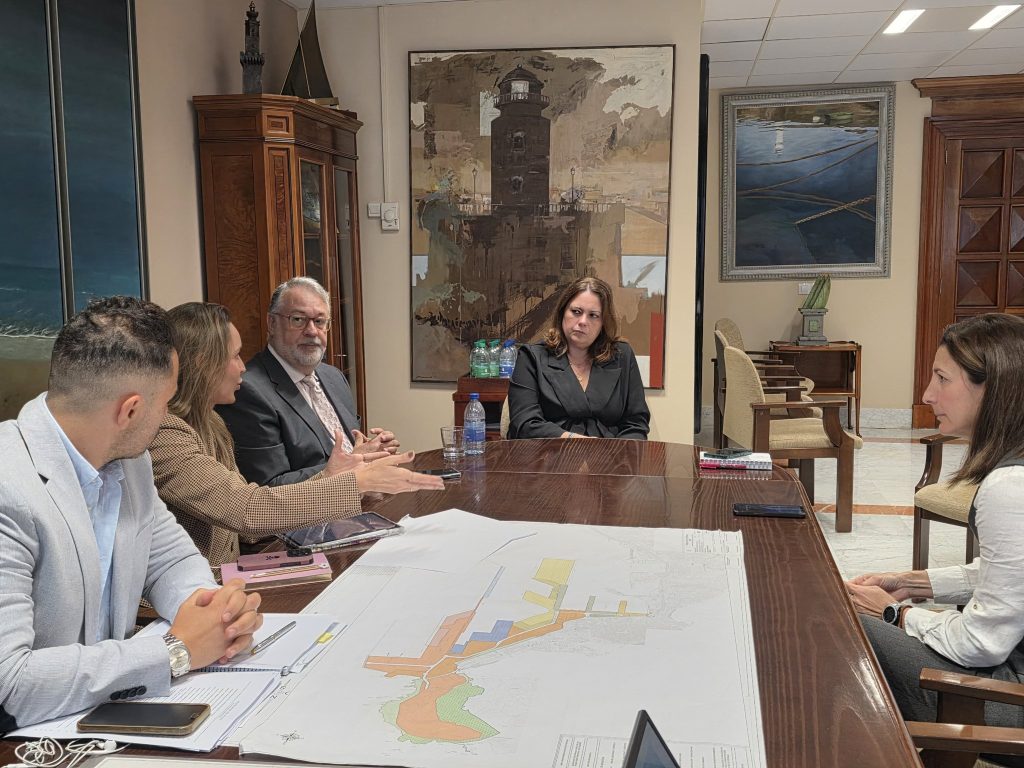
Beatriz Calzada, president of the Port Authority of Las Palmas, held a technical meeting on Tuesday with the managers of Pirineos Drone and the Aerospace Cluster of the Canary Islands. The objective of the meeting was to analyze a cargo transport system using unmanned aerial vehicles designed specifically for the port environment. This project will compete in the upcoming call for the Ports 4.0 capital fund, the main model for open innovation for Spanish ports. In the port of Las Palmas, there are already operators with investments in this sense without resorting to public funds.
The initiative seeks to transform conventional logistics at the docks through the use of aerial technology. The transport of spare parts, medical supplies, or critical documentation between land and ships at anchor would drastically reduce wait times and the carbon footprint. The APLP has confirmed its institutional support for the proposal, considering it a strategic tool to gain competitiveness in the Central Atlantic.
The Director General of Transport for the Government of the Canary Islands, María Fernández, also participated in the working sessions. Her presence underscores that the integration of drones is not an isolated experiment of the port community, but rather a key element of regional mobility policy. The regional government and the port seek to establish a safe operational framework that allows the islands to lead short-distance air logistics.
The collaboration with the Aerospace Cluster of the Canary Islands ensures that technological development has an industrial anchor in the archipelago. Pirineos Drone brings technical expertise in cargo platforms, while the cluster acts as a bridge for local talent to participate in the deployment of the project. This cooperation ecosystem is one of the most highly valued conditions by Ports of the State for the granting of financial aid.
The application of drones at La Luz would alleviate congestion from auxiliary service vessels during smaller operations. In a port with a high density of activity like Las Palmas, agility in ship-to-shore supply represents a competitive advantage over other regional hubs. The automation of these processes not only reduces costs for shipping companies but also improves safety by minimizing human maneuvers under adverse sea conditions.
The project will now enter the evaluation phase within Ports 4.0, where it will compete for funds aimed at digitalization and sustainability. If financing is obtained, Las Palmas would become one of the first ports in the state network to normalize cargo drone flights in its daily operations.







